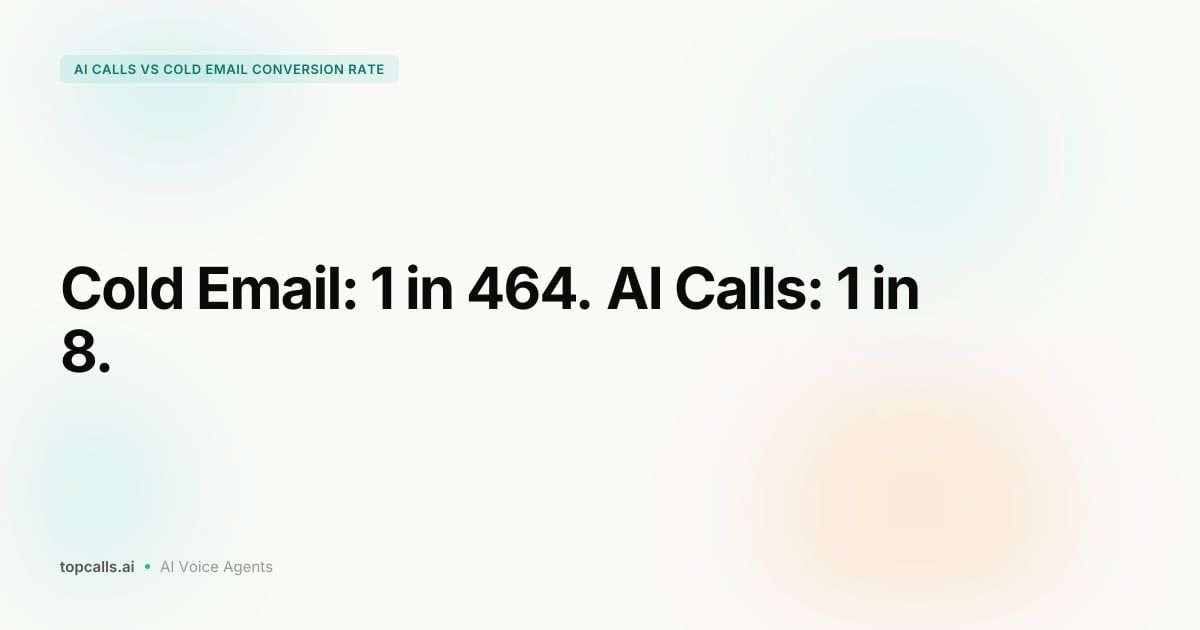
1 in 464 cold emails closes a customer. That's the average B2B conversion rate in 2026, and it's been declining for 6 straight years.
Meanwhile, AI sales calls are converting prospects into qualified leads at 8-15% per conversation. If you're comparing AI calls vs cold email conversion rate, the gap isn't subtle anymore. It's structural — built into how each channel qualifies buyers.
Email inboxes are overloaded, reply rates keep dropping, and AI calling has solved the scale problem that made phone outreach impractical for most teams. This piece breaks down why the conversion math has shifted, what the actual numbers look like, and how to structure your outbound around both channels.
Key Takeaways
- Cold email closes about 1 deal per 464 emails (0.2%), while AI sales calls qualify 8-15% of every conversation.
- A human SDR makes 40-60 calls per day; an AI system running on TopCalls makes 1,000 in the same window.
- TopCalls AI voice agents run first-touch conversations at sub-500ms latency and capture full BANT qualification in one call.
- At $0.35 per minute, calling high-ACV prospects is justified by the qualification depth email cannot deliver in a single touch.
- Teams pairing AI calls for qualification with email for nurture see meeting booking rates 1.5-3x higher than either channel alone.
1. What Cold Email Actually Converts at in 2026
The benchmarks for cold email aren't what the software vendors advertise. Here's what the data actually shows:
Open rates: 18-22% in 2026, down from 25% in 2020. And thanks to Apple's Mail Privacy Protection inflating opens, those numbers are softer than they look.
Reply rate: 3.43-5.8% for a well-run cold campaign. Exceptional campaigns can hit 10-15%. Most teams are stuck at the low end.
Meeting booking rate: 0.5-2% per campaign. That's meetings booked per email sent — not per reply, per email.
Close rate: 0.2153% average. 1 closed deal per 464 emails. For teams sending 5,000 emails a week, that's 10-11 deals. For teams sending 200 a week, it's less than one per month.
Email ROI looks impressive on paper ($36-42 returned per $1 spent) until you account for what it takes to hit those numbers. Deliverability infrastructure, list hygiene, copywriter time, A/B testing. The top-end ROI belongs to top-end teams with dedicated resources. Most organizations operate closer to the average.
And none of this addresses the qualification problem. A reply to a cold email is a single data point. It doesn't tell you budget, timeline, decision authority, or whether the company is actively buying or just browsing.
2. Why AI Sales Calls Convert at a Different Rate
Phone has always outperformed email on conversation rate. The problem was cost and scale. A human SDR makes 40-60 calls per day. An AI system running on TopCalls makes 1,000.
At that scale, the conversion numbers look very different from email:
Connect rate: 45-65% on warm leads.
Conversation engagement: 15-22% of prospects who answer engage meaningfully with the AI agent.
Qualified lead rate per conversation: 8-15%. Compare that to 0.5-2% via email.
A team running 1,000 AI calls per day at a 12% qualified lead rate produces 120 qualified leads daily. The same 1,000 emails on a strong campaign produce 5-20 qualified leads. That's a 6-24x difference in output — before you account for the depth of what you know about each lead.
Buyer preference data supports this too. 57% of C-level and VP buyers say they prefer being contacted by phone. 82% of buyers have accepted meetings from a strategic cold call. For high-ACV B2B sales, the channel your buyers prefer isn't email.

Want to see what this looks like for your specific call volume and deal size? Use the AI cold calling ROI calculator to get a cost-per-meeting estimate alongside your current email campaign numbers.
3. The Qualification Problem Email Can't Solve
Here's what a 90-second AI call captures that email almost never does: budget range, decision timeline, current vendor situation, active pain points, buying authority, and intent level. All in one conversation, in real time.
A reply to a cold email gives you one of three things. "Not interested." "Send me more info." Or silence. The first is actually useful — you can stop wasting time on that prospect. The second is weak signal. The third is what you get 60-70% of the time.
TopCalls AI voice agents run those first-touch conversations at sub-500ms latency. The agent captures full BANT qualification, updates the CRM in real time, routes hot leads to a human rep, and schedules follow-ups automatically. No human involved in the first touch.
For B2B sales with long cycles and multiple stakeholders, that qualification depth changes how reps spend their time. They stop burning hours on discovery calls with people who were never going to buy. Every conversation starts with a prospect who's already spoken to the AI, expressed interest, and been scored.
That's the core of what AI-powered lead qualification does that email sequences can't replicate, regardless of how good the copy is.
4. Speed to Pipeline: Hours vs. Weeks
Cold email qualification takes time. You send. You wait. You follow up. You wait again. The average B2B email sequence runs 5-7 touches over 2-4 weeks before a meaningful reply — if you get one at all.
AI calling compresses that to hours. A rep uploads a lead list on Monday morning. By Monday afternoon, qualified leads are in the CRM and hot prospects are already scheduled for a follow-up call with a human.
Speed matters because buyers' windows are short. Responding to a high-intent lead within 5 minutes is 9x more effective than waiting an hour. Email can't win that race unless your team is watching inboxes 24/7 and responding instantly to every positive reply.
The sales acceleration use case is where AI calling creates the most visible ROI. Volume is part of it. But faster pipeline velocity matters just as much — shorter sales cycles mean more closed deals per quarter without adding headcount.
For a step-by-step breakdown of how to set up a 1,000-call-per-day operation, the guide on running AI sales calls at scale covers the full setup from list prep to CRM sync.
5. When to Use AI Calling vs. Cold Email (and When to Use Both)
AI calling doesn't make email irrelevant. They solve different parts of the funnel, and the best outbound teams use both intentionally.
First-touch qualification on cold lists: AI calls. You need BANT data fast, and email can't deliver it in one touch.
High-ACV prospects (deals over $20k): AI calls. These buyers respond better to phone, and the qualification depth more than justifies $0.35/minute.
Nurture after a qualified call: Email. Once a lead has been qualified by phone, email is the cheapest way to stay top of mind while they move through their internal decision process.
Re-engaging a cold database: AI calls. A 90-second conversation re-qualifies a dormant lead faster than 5 nurture emails.
Event follow-up and content distribution: Email. For top-of-funnel awareness where volume matters more than depth, email's cost advantage holds.
Teams combining both channels consistently see meeting booking rates 1.5-3x higher than either channel alone. AI calls handle first-touch qualification. Email handles nurture and re-engagement. Each does what it does best.
For the framework to track both channels together, the AI cold calling metrics guide covers which KPIs to watch across calling and email in the same reporting view.
6. Where AI Sales Calls Don't Win
Worth being direct about the cases where calling isn't the right first move.
Long relationship-building sequences: If your sales model relies on 6 months of content-driven warming before outreach, AI calling isn't the right tool. It's built for first-touch qualification, not slow-burn relationship development.
Highly regulated industries with complex consent requirements: TCPA compliance is built into TopCalls, but if your prospect pool requires multi-step written consent before any AI contact, factor in the operational overhead. The TCPA compliance guide covers consent rules by state and industry vertical.
Ultra-low ACV deals (under $500): If deal size is small and margin is thin, even $0.35/minute calling needs to pencil out against high-volume email. Run the numbers in the ROI calculator before committing to a calling-first strategy.
If you're evaluating whether to shift budget from email to AI calling, the SDR cost vs AI sales agent comparison puts the full cost-per-lead math side by side.
If your pipeline depends on cold email and you're hitting 0.2% conversion, that's 1 deal per 464 emails. AI calling at 10-12% qualified lead rate produces 100-120 qualified conversations per 1,000 calls. The math isn't close. The question is just whether the economics work for your deal size and your list.
Want to see what those numbers look like for your specific ICP and deal size? Book a strategy call with the TopCalls team — we'll map it out before you commit to anything.
Frequently Asked Questions
Get AI calling tips in your inbox
No spam. One email per week with actionable sales automation tips.