Mortgage brokers average 500+ inbound leads a month. Most loan officers actually work 3 or 4 of them before the afternoon is over. The rest sit in a CRM queue for hours, sometimes a full day, while the borrower shops around. AI voice agents for mortgage teams don't just speed up outreach. They change which leads ever reach a loan officer's desk.
This is a 90-day case study from a mid-size mortgage brokerage that ran a pilot with TopCalls. Before: 14 booked qualified calls per week across 6 loan officers. After: 19.6. A 40% jump. Here's the workflow that got them there.
Key Takeaways
- A mid-size brokerage running TopCalls booked 40% more qualified calls in 90 days, rising from 14 to 19.6 per week.
- TopCalls cut average lead response time from 4.2 hours to under 2 minutes, with the first call triggering within 90 seconds of form submission.
- The AI setup ran at less than 30% of a second SDR's monthly cost while outperforming the headcount scenario by month two.
- Loan officers opened transferred calls already knowing credit range, property type, and timeline, shortening the first call from 22 minutes to 14.
- The approach did not help referral or jumbo and non-QM borrowers, who expected a human on the first call and needed a separate intake path.
The Problem Loan Officers Kept Describing the Same Way
The team had 6 loan officers and a shared SDR handling inbound leads and warm follow-up. The SDR worked 8 leads simultaneously, which pushed lead response time to an average of 4.2 hours from form submission. That's a long lag. Research on mortgage lead conversion consistently shows that calling within 5 minutes generates 21 times higher conversion than calling at 30 minutes. Nobody on the team argued with the math.
The obvious fix was another SDR. But that meant roughly $4,800/month in salary plus benefits, and the business case was hard to make. Lead volume was 340/month. The math could have worked, but the team didn't want a full-time hire to solve what they suspected was a workflow problem.

On top of the response time issue, the SDR spent roughly 30% of each day on leads that would never convert: incomplete applications, credit scores below threshold, properties outside the firm's service area. Every hour on a dead-end lead was an hour not spent on a borrower ready to act.
AI Voice Agents for Mortgage Brokers: What the Setup Looked Like
The brokerage connected TopCalls' AI voice agents to their lead CRM via webhook. When a new form submission came in, the first call triggered automatically. Median time from form submission to first contact: under 90 seconds.
- Loan purpose (purchase or refinance)
- Property type and location (is it inside the firm's service area?)
- Estimated credit score range
- Down payment available (purchase) or current equity (refinance)
- Employment status and income range
- Purchase timeline (buying within 30 days vs. 6 months changes how leads get prioritized)
- Pre-approval status
Leads that cleared the thresholds went into a hot queue and either transferred directly to an available loan officer or got booked on their calendar. Leads that didn't qualify were flagged with a reason code in the CRM. This lead qualification approach applies across financial services, though mortgage has more specific threshold criteria than most industries. For more on how AI handles lead pre-screening at this stage, that post covers the logic in depth.
The configuration took about 3 weeks from first setup to production. The first two weeks surfaced edge cases the team hadn't anticipated. Investors calling about rental properties needed different routing than primary purchase buyers. Borrowers wanting to refinance with equity below threshold needed a hold-and-nurture tag rather than a flat rejection. Getting those edge cases mapped was slower than the initial build.
Results After 90 Days
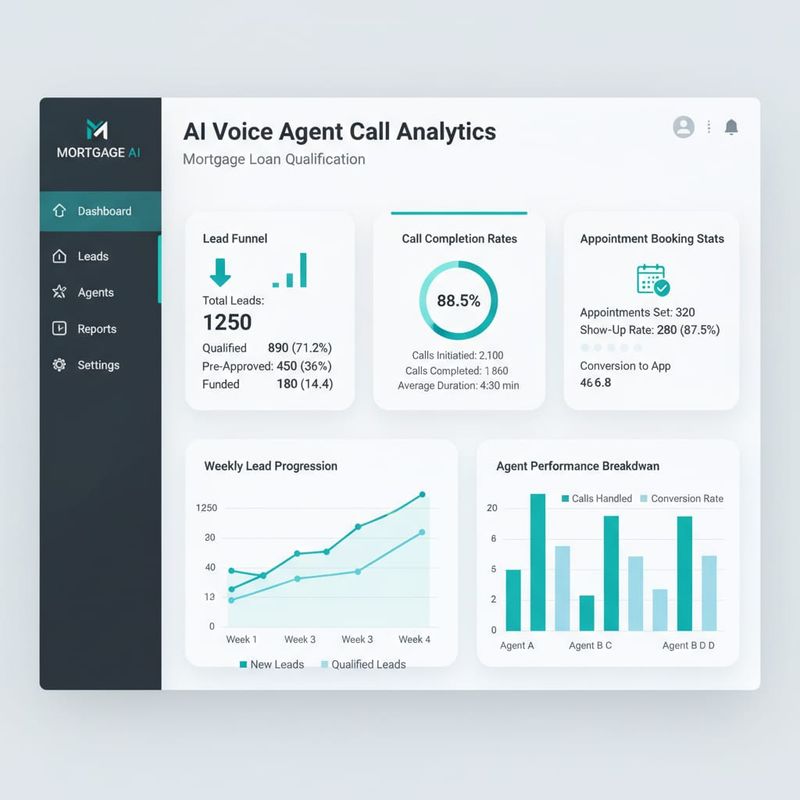
Booked qualified calls per week went from 14 to 19.6 on average. That's the 40% number. It held consistently after week 3 and didn't spike in one anomalous week. The team ran the same number of loan officers throughout. No new hires.
Lead response time dropped from 4.2 hours to under 2 minutes on average across all inbound submissions. That's across weekends, holidays, and non-business hours when the SDR was offline. Every lead that submitted a form got a call within 90 seconds.
The SDR's time on dead-end leads fell from roughly 30% of their day to under 9%. Those recovered hours went into follow-up sequences for leads who needed more nurturing, which the team had no bandwidth to run before. If you want a breakdown of what SDR costs look like versus AI alternatives, this SDR cost vs. AI comparison has the full numbers.
Average loan officer utilization improved too. Before the pilot, LOs spent roughly 22% of their time on leads that stalled before qualification. That dropped to under 6%. They spent the recovered time on borrowers already moving through the pipeline.
The brokerage didn't eliminate the SDR role. The SDR shifted to handling complex edge cases, referral relationships, and borrowers who requested a human callback on the first call. That's a better use of the role.
Cost comparison: the AI setup ran at less than 30% of what a second SDR would have cost monthly. With the 40% jump in booked qualified calls, the revenue potential outperformed the headcount scenario by the end of month two. You can model your own numbers at the AI ROI calculator if you want to see what the math looks like for your lead volume and close rate.

AI Calling for Loan Officers: Where the Hand-Off Happens
One thing that surprised the team early in the pilot: borrowers didn't push back on the AI call at the start. The voice was natural enough that most people answered the qualification questions without friction. The pushback appeared somewhere different, when borrowers wanted to discuss rate expectations or specific loan products.
The system wasn't designed for those conversations, and it didn't try. Any question outside the qualification script triggered a callback from a loan officer. That boundary is important. AI voice agents work best for appointment setting and lead qualification when they have a tight, defined scope. Trying to turn them into loan officers would have broken the whole thing. The full AI appointment setting workflow has more detail on how to design the scope correctly.
The hand-off was where the real value showed up. When a loan officer picked up an AI-transferred call, they already knew the borrower's credit range, property type, loan purpose, timeline, and down payment before saying hello. That context change shortened the average first call from 22 minutes to 14 minutes.
Teams that want to run outbound prospecting on top of inbound qualification can pair this with AI cold calling for a full-stack approach. The inbound qualifier handles form submissions. The outbound agent works cold leads or re-engagement campaigns.
AI Calling for Loan Officers: Compliance and What to Watch For
Mortgage is a regulated industry. Two things to sort out before running any AI calling program.
First, consent language on your lead forms. If you're calling via automation, your form submission copy needs to cover it. This is standard practice for any outbound calling under TCPA guidelines, AI or human. The brokerage had compliance counsel review the form language before the pilot launched.
Second, call recording and logging. Every call the AI agent placed was logged with a full recording and a transcript, stored against the lead record in the CRM. For RESPA compliance or fair lending reviews, that trail matters. AI-logged calls turned out to be more consistent records than SDR notes, which varied in quality depending on who took the call.
The same compliance framework applies across financial services. The AI calling for financial services breakdown goes into more depth on how to structure logging, consent, and audit trails if your firm needs a step-by-step guide.
Where This Doesn't Work for Mortgage Teams
Vendor case studies almost never include this section. This one does.
AI voice agents didn't work for referral leads in this pilot. Borrowers coming through a realtor or financial advisor relationship expected a human on the first call. Running them through the same automated flow hurt conversion in that segment. The team built a separate intake path for referral leads and kept those with the SDR.
They also didn't work for jumbo or non-QM borrowers. The qualification criteria are more complex, the conversations require more judgment, and borrowers in that segment were less tolerant of automated screening. Different workflow entirely.
If your book skews heavily toward referral business or non-conforming products, AI voice agents may not move the needle the way they did here. The 40% gain came almost entirely from internet leads and pay-per-click traffic, where volume is high and qualification criteria are clear.
FAQ: AI Voice Agents for Mortgage Brokers
What are AI voice agents for mortgage brokers?
AI voice agents for mortgage brokers are automated phone systems that call leads within seconds of form submission, run through a qualification script, and route qualified borrowers directly to loan officers or book them on their calendar. They handle initial contact without human involvement until the borrower clears your qualification thresholds.
How do AI voice agents qualify mortgage leads?
The agent asks borrowers a series of questions covering loan purpose, property type and location, estimated credit score range, down payment or current equity, employment status, income range, and buying timeline. Answers are checked against your qualification criteria automatically. Leads that qualify get transferred or booked. Leads that don't qualify are flagged with a reason code in the CRM.
What's the ROI of AI calling for loan officers?
In this case study, a mid-size brokerage saw 40% more qualified booked calls at less than 30% of the cost of hiring an additional SDR. The ROI depends on your lead volume, current close rate, and average loan values. Faster lead response time, from hours to under 2 minutes, typically drives meaningful conversion improvement on internet leads.
Is AI calling compliant for mortgage brokers?
Yes, when set up correctly. TCPA consent language on your lead forms must cover automated calling. Call recordings and transcripts should be stored against each lead record in your CRM. Consult compliance counsel before launching. Many mortgage teams find AI-logged calls produce more consistent audit records than hand-written SDR notes.
The 40% gain in this case came from one change: faster qualification on higher lead volume. The loan officers didn't change how they sold. They just spent more time talking to borrowers who already cleared the bar. If that's the kind of workflow you want to build, talk to our team and we'll walk you through what setup makes sense for your lead volume and brokerage structure.
Frequently Asked Questions
Get AI calling tips in your inbox
No spam. One email per week with actionable sales automation tips.