Speed to lead is the gap between the moment a lead arrives and the moment you first reach them by phone. Close that gap to under 5 minutes and you are 21x more likely to qualify the lead than a team that calls at 30 minutes, per the MIT/InsideSales.com Lead Response Management study. Most companies average closer to 42 hours. That gap is where deals quietly die, and it is the single cheapest number in sales to fix.
Key Takeaways
- Call a new lead within 5 minutes instead of 30 and you are 21x more likely to qualify it and 100x more likely to even connect (MIT/InsideSales.com).
- The average company takes about 42 hours to respond to a web lead, and only 37% answer within the first hour (Harvard Business Review).
- Roughly 27% of inbound leads never get a single contact attempt, so speed is often the difference between a conversation and silence.
- Topcalls fires the first call within seconds of a lead arriving, at $0.35 per minute all-inclusive and sub-500ms voice latency, with no business-hours gap.
- An AI voice agent removes the human bottleneck that causes lead decay: it never sleeps, never sits in a queue, and runs 63,000+ calls a day.
Why does speed to lead matter?
Speed to lead matters because buyer intent is highest the second a form is submitted and falls off fast after that. A prospect who just asked for a quote is at the keyboard, thinking about the problem, and usually shopping three or four vendors at the same time. The first company to call gets the warm conversation. Everyone else inherits a colder, half-decided buyer.

The math is brutal once you put numbers on it. The 2007 MIT/InsideSales.com Lead Response Management study analyzed more than 15,000 leads and 100,000 call attempts and found the odds of qualifying a lead drop 21x between a 5-minute and a 30-minute call. The odds of even reaching the person drop 100x over that same half hour.
It compounds at scale. If your team calls every lead two hours late, you are not losing one deal, you are taxing every deal in the pipeline. The teams that win are not better closers. They are first. Getting first is a process problem, and process problems get solved with AI voice agents for sales acceleration that call the instant a lead lands.
What happens to conversion after 5 minutes?
After 5 minutes, conversion falls off a cliff and keeps sliding. Wait 10 minutes instead of 5 and your odds of qualifying the lead drop sharply. Wait an hour and you are competing with everyone else who also waited. The 5-minute mark is not a soft target, it is the edge of the window where a lead still behaves like a hot lead.
Harvard Business Review put a hard number on the cost of the delay. In The Short Life of Online Sales Leads, researchers James Oldroyd, Kristina McElheran, and David Elkington audited 2,241 US companies and found firms that called within an hour were nearly 7x more likely to qualify the lead than those that waited even one extra hour. Only 37% managed to respond within that first hour at all.
Firms that tried to contact potential customers within an hour of receiving a query were nearly seven times as likely to qualify the lead as those that tried to contact the customer even an hour later., Oldroyd, McElheran, and Elkington, Harvard Business Review
Lead decay is also psychological. A buyer who fills out three forms remembers the brand that called back first and forgets the two that did not. By the time a slow team dials, the prospect has often already booked a call with a faster competitor. Speed does not just lift conversion, it removes the rival from the conversation.
How fast can an AI voice agent call a new lead?
An AI voice agent can call a new lead in seconds, not minutes. Topcalls listens for the lead event from your CRM or a webhook and dials immediately, with sub-500ms voice response latency once the call connects. There is no queue, no shift change, and no waiting for a rep to finish another call, so a form filled at 2am gets a real conversation at 2:01am.
That speed is structural, not heroic. A human SDR can hit a 5-minute response on a good day, but not at 3am, not during lunch, and not on lead number 80. Topcalls runs 63,000+ calls a day across 32 languages, and the 1st call lands the same whether it is the 1st lead of the day or the 800th. Consistency at the 5-minute mark is the whole game.
It also handles the part humans hate: the retry. When the first dial goes to voicemail, Topcalls applies smart retry logic that calls back in minutes on a busy signal, hours on an unanswered ring, and an hour after a failed connection, so the lead never falls into a dead queue.
Want to see what slow response is costing you in lost deals? Run the numbers in our ROI calculator and put a dollar figure on every minute a lead waits.
What's the average lead response time?
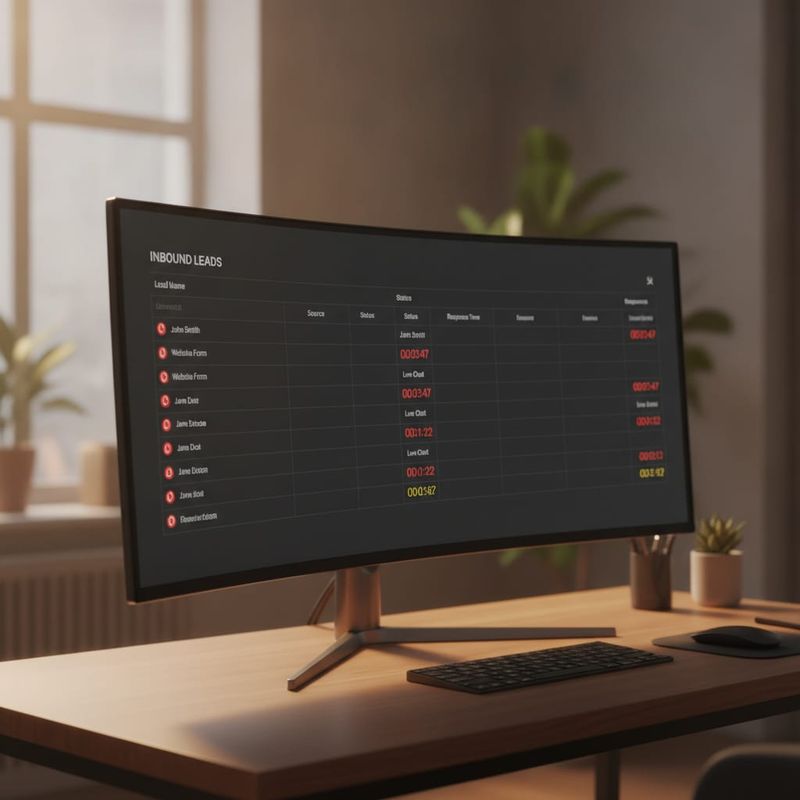
The average lead response time is measured in dozens of hours, not minutes. The Harvard Business Review audit found an average first-response time of about 42 hours across 2,241 companies. Newer 2025 benchmarks tell the same story: most B2B teams still respond in many hours, and only about a quarter of inbound leads ever get a contact attempt at all.
Here is how the response windows stack up against the odds of qualifying the lead, pulled from the studies above:
| Response window | Who hits it | Relative odds of qualifying |
|---|---|---|
| Under 1 minute (AI callback) | Topcalls, instantly | Highest, beats the 5-min benchmark |
| 5 minutes | Best human teams | Baseline (21x better than 30 min) |
| 30 minutes | Average fast team | 21x lower than 5 minutes |
| 1+ hour | Only 37% of companies | ~7x lower than within the hour |
| 42 hours (average) | The typical company | Lead is effectively cold |
The gap between the benchmark and reality is the opportunity. If the typical competitor calls at 42 hours and you call at 42 seconds, you are not slightly ahead. You are reaching the buyer while they are still at the keyboard and everyone else is reaching a stranger who has already bought.
How do you automate instant lead callbacks?
You automate instant lead callbacks by wiring the lead source straight to an AI voice agent, so a form submission triggers a call with no human in the loop. The setup is a same-day job, not a quarter-long project. Topcalls campaigns go live in about 15 minutes of configuration, then the agent calls every new lead, qualifies it, and books or routes it.
The pattern looks like this:
- Connect the source. Point your web form, ad lead, or CRM straight at Topcalls through the integrations layer (Salesforce, HubSpot, Pipedrive, Close, or a webhook), so a new lead fires an event the instant it lands.
- Trigger the call in seconds. The agent dials immediately, opens with a natural greeting, and confirms the lead actually wants what they asked for, before any pitch.
- Qualify on the call. Use AI lead qualification to score budget, authority, need, and timeline live, so only real buyers reach a human.
- Book or route. The agent drops the meeting straight onto a rep's calendar or warm-transfers a hot lead, then sends the follow-up automatically.
Speed to lead is the first touch, not the only one. Pair the instant callback with automated follow-up after the AI sales call so the leads you reach first do not leak out the back the way most slow-followed-up pipelines do.
When is speed to lead the wrong move?
Speed to lead is the wrong move when a robotic instant call would damage a high-trust relationship. On seven-figure enterprise deals, a buyer who fills out a contact form often expects a thoughtful, personal reply, not a phone ringing 12 seconds later. Speed still helps, but the right answer is a fast, human-sounding qualifying call that confirms fit and books time, not a hard pitch.
It also backfires when speed is not paired with quality. A fast call that drops, stutters, or feels canned can do more harm than a slightly slower one that sounds right. That is why latency and call delivery matter as much as raw speed, and why cutting call abandonment to zero is part of any serious speed-to-lead play.
For most inbound, though, the risk runs the other way. The far bigger problem is the 42-hour callback, not the 42-second one. The teams worrying about being too fast are rare. The teams losing deals to a competitor who called first are everywhere.
Every minute a lead sits in a queue, its value drops. An AI voice agent that calls in seconds, qualifies on the line, and books the meeting closes that gap permanently, and it does it at $0.35 a minute instead of the cost of a fully loaded SDR. See how that cost per appointment compares to a human SDR, or book a strategy call and we will map your lead flow to a sub-minute callback.
Frequently Asked Questions
Get AI calling tips in your inbox
No spam. One email per week with actionable sales automation tips.