A trader who says "let me talk to a person" and gets a third scripted line hangs up, and remembers it. Human handoff in AI calls for forex brokers is the set of rules that decides, mid-call, when the AI voice agent stops and a person takes over, and what that person gets handed. Get the rules wrong in one direction and your account managers spend the day answering questions the agent could've finished. Err the other way and a complaint lands in a regulator's inbox with your AI's voice on the recording.
This guide covers the triggers that should fire a handoff, warm transfer versus callback, the five fields the human needs on screen before they say hello, what the agent does when nobody's on shift, and how to measure it. It's written for the ops, retention or dealing-desk lead who owns the calling program and the people behind it.
Key Takeaways
- Two triggers are unconditional on any AI call to a trader: the trader asks for a person, and any mention of a complaint, regulator or chargeback. Both stop the pitch.
- Warm transfer only when a desk is open in the trader's language and the hold will stay under about 60 seconds; otherwise the agent books a callback.
- The FCA's FG21/1 guidance expects frontline staff to recognise and respond to characteristics of vulnerability, so distress on a call is a handoff trigger, not an objection to handle.
- Article 50(1) of the EU AI Act, applying from 2 August 2026, requires people to be informed they're interacting with an AI system, so "is this a robot?" gets a yes and then a handoff offer.
- Topcalls bills $0.35 per minute all-inclusive, so 200 handed-off calls averaging 3 minutes of agent time cost $210 of AI before the first human minute.
1. What is a human handoff in AI calls for forex brokers?
A human handoff is the moment an AI voice agent stops running its script and routes the trader to a person, either live on the same call (a warm transfer) or through a booked callback. In a forex or CFD brokerage the handoff carries the trader's account status, the campaign, the trigger that fired and a transcript, so the account manager or compliance officer never asks the trader to start over.
It isn't an escape hatch for a weak script. If the agent hands off 30 percent of connected calls, you have a script problem, and the humans are doing work the agent could finish. Most dormant-trader reactivation, deposit follow-up and KYC reminder calls run by AI voice agents should end without a person ever joining.
The reverse failure is quieter. An agent that keeps pitching a deposit bonus into "I want to complain about my withdrawal" produces a recording you'll hear again during a regulator review. So the rules live in two lists: where a person adds something the agent can't, and where the agent must stop selling whether or not anyone is free.
2. Which triggers should force an AI call to hand off?
Nine triggers cover nearly every trader call: the trader asks for a person, a complaint or regulator comes up, a deposit or withdrawal above a set amount, a question needing a qualified answer on margin or suitability, a KYC or account block, an intent to close the account, signs of distress, two failed understandings in a row, and a language the agent can't hold. Each gets a handoff type and priority before launch.
| Trigger | How the agent detects it | Handoff type | Priority |
|---|---|---|---|
| Trader asks for a person | "Let me speak to someone", "is this a robot", in any campaign language | Warm transfer if a desk is open, else callback | High |
| Complaint, chargeback or regulator | Keywords: complaint, ombudsman, regulator, dispute, chargeback, lawyer | Warm transfer to compliance-trained staff; pitch stops | Highest |
| Deposit or withdrawal above a threshold | Amount stated on the call or read from the CRM record | Warm transfer to account manager | High |
| Question needing a qualified answer | Topic list: margin call, suitability, tax; agent doesn't answer | Callback from a qualified person within a set number of hours | High |
| Distress, confusion or vulnerability | Mentions of illness, debt, gambling, being pressured to trade | Stop the pitch; trained person, or end politely and flag | Highest |
| Agent fails to understand twice | Two fallback responses in a row | Offer a person or a callback; never loop a third time | Medium |
Two triggers can fire on one call. A trader who says "I want to close this, and I've already written to the ombudsman" is a retention lead and a complaint at once. Decide the order once: vulnerability first, then complaint, then asks for a person, then the money threshold, then everything else. A retention pitch into a complaint is how a call ends up in a regulator's inbox.
Vulnerability deserves its own phrase list. The FCA's finalised guidance FG21/1 on the fair treatment of vulnerable customers says firms should make sure frontline staff can "recognise and respond to a range of characteristics of vulnerability", and names poor health, life events, low resilience and limited capability as the four drivers. On an outbound campaign the AI agent is the frontline. A mention of debt, illness, gambling or being pushed to trade stops the pitch; a trained person takes over, or the call ends politely and is flagged for review next morning.
"Is this a robot?" is a disclosure question and a handoff trigger at once. Article 50(1) of the EU AI Act requires that AI systems meant to interact with people are built so that "the natural persons concerned are informed that they are interacting with an AI system", and Article 50 applies from 2 August 2026. The agent says yes, then offers a person. Wording by region is covered in the post on AI call disclosure for brokers and the wider guide to AI disclosure laws.
The handoff workflow template puts those nine triggers in a fill-in table with detection phrases, handoff type and priority, then adds the desk-hours grid, the fallback list, the CRM outcome codes and a weekly review sheet.
3. Warm transfer or callback: which should the AI offer?
Warm transfer when the trader is engaged now, a desk is open in their language, and the hold will stay under your limit; a callback in every other case. A warm transfer that rings for 90 seconds on a call that has lasted 2 minutes loses the trader. But a callback the agent books to a named slot, confirms by SMS and writes to the CRM keeps them.
The hold limit is the number most brokerages never set. Pick one shorter than your average handled call. Sixty seconds is a common starting point; measure and adjust after the first week. Past the limit, the agent switches to the callback offer on its own.
- Bridge line: the agent names who's coming and confirms the trader won't repeat themselves. "I'm bringing in Maria from the account team, she can see our conversation." Naming the person is what stops the trader hanging up during the ring.
- Callback slot: two concrete times in the trader's timezone, one booked, a confirmation sent by SMS or email, and the slot written to the CRM with an owner.
- Hold flag: a CRM flag that pauses every other campaign for that trader until the callback is done, with an expiry so an unclosed callback doesn't suppress the trader for good.
- Stop-selling triggers: for complaints, vulnerability and regulator mentions the bridge line is neutral. "I'll get a colleague to help with that." No last offer, no bonus.
On a dormant trader reactivation campaign the transfer is usually worth it: the trader has just asked "what's changed on the platform?" and an account manager can answer in the same breath. Topcalls replies in real time, so the bridge line lands before the trader wonders whether the line dropped. On a KYC reminder campaign the callback wins, because the person who can clear a document check isn't sitting on a phone queue.
4. What context must reach the human before they say hello?
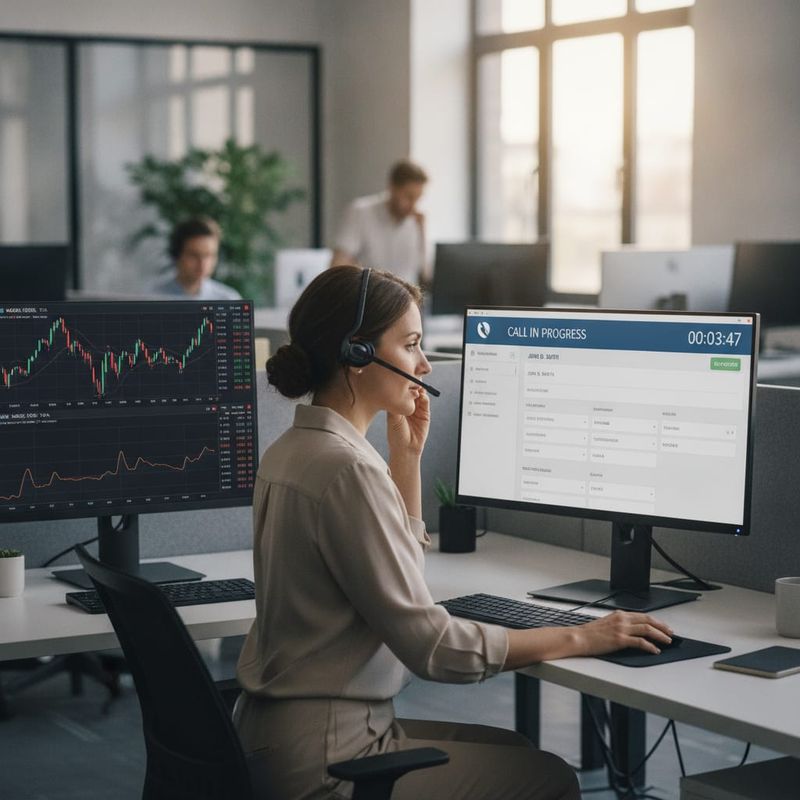
Five fields, on screen before the human unmutes: who the trader is and their current account status, which campaign called and why, the trigger that fired with the trader's exact words, a short transcript or summary, and anything the agent already promised. If the human's first question is "so what were you calling about?", the handoff failed, whatever the transfer log says.
- Account status from the trading platform: for an MT4 or MT5 broker this comes from the platform, not the marketing CRM. A frozen account, a pending withdrawal or an open margin call changes the human's first sentence.
- Campaign and offer: which list the trader was on, what the agent was allowed to offer, and whether the trader already declined it.
- Trigger and verbatim: the trigger code plus the trader's actual words. "COMPLAINT_FLAG: 'my withdrawal has been pending for nine days'" beats the code alone.
- Transcript and disposition so far: the last 60 seconds as text, and the disposition the agent was about to log.

Topcalls pushes that record through Integrations to HubSpot, Salesforce or a broker CRM as a screen pop, and the same automation path connects 764+ tools, so the transcript can also land in the desk lead's Slack channel. The post on automating call outcomes and CRM updates covers the field mapping. One rule matters here: the agent opens the handoff record and the human closes it, on one record, every time.
5. What happens when nobody can take the call?
The agent apologises once, states the next desk opening in the trader's local time, books the earliest slot, and ends the call. A complaint outside hours gets logged as a complaint and the compliance owner is notified the same night. Distress flagged outside hours means no automated contact until a person has reviewed the recording. "Someone will be in touch" with nothing behind it isn't a fallback.
Desk hours are where multi-market campaigns break. A campaign calling Dubai, Lagos and Sao Paulo from a London desk has three different open windows. The AI agent works all of them; the humans don't. Topcalls runs calls in up to 78 languages and a human desk usually covers three, so the availability grid lists the languages each desk can take, not the ones the agent speaks. A handoff in a language nobody on shift speaks is a callback.
The complaint fallback has a clock on it. Under FCA DISP 1.6.1R a firm must send the complainant a prompt written acknowledgement, and under DISP 1.6.2R the final response is due by the end of eight weeks after receipt of the complaint. Receipt is the AI call. If a COMPLAINT_FLAG sits in a queue until Monday, three days of the eight weeks are gone before anyone has heard the recording.
Cap handoff attempts per trader per week across every campaign. Transferred, missed, called back and texted four times in one week isn't service, it's chasing. When the CRM, dialer or phone system goes down, the agent gives a direct number and the campaign pauses.
6. How do you measure whether the handoff is working?
Seven numbers, reviewed weekly: handoffs by trigger, handoff rate (handoffs divided by connected calls), warm transfer success, median trigger-to-human time, callbacks kept on time, the outcome after handoff (deposits, retained accounts, resolved complaints as your CRM defines them), and AI minutes spent before handoff. Change one trigger or one threshold a week at most, so the numbers tell you what moved.
The last one is the cost line. Topcalls bills $0.35 per minute all-inclusive, so 200 handed-off calls averaging 3 minutes of agent time cost $210 of AI before the first human minute. Set that against the human minutes those 200 conversations would have consumed with no agent, covered in the AI calls vs human agents cost comparison, and against what the reactivated deposits are worth, which the dormant trader revenue calculator estimates from your own numbers.
Then read transcripts. Ten handed-off calls, to check the trigger fired at the right moment, and ten that should have handed off and didn't. Search for "speak to someone", "is this a robot" and the local equivalents in every campaign language. Every miss becomes a new trigger phrase. It's the same weekly habit as quality assurance for AI voice calls, and one reviewer can do both.
If a trigger fires a dozen times a week on the same objection, that's a script fix, not a routing fix; send it to whoever owns the objection handling flows. And if it fires because withdrawals really are taking nine days, send it to payments. No handoff workflow fixes a product problem.
7. When this doesn't fit
A handoff workflow doesn't fit when there's no desk to hand to, when the campaign is pure notification, or when the complaint rate says the campaign shouldn't be running at all. Then the agent finishes the call, logs the outcome and books nothing beyond a callback. Building nine routes to an empty room is worse than one honest callback.
- No human desk: a two-person brokerage running reactivation at night has nobody to transfer to. Keep the asks-for-a-person and complaint triggers, route both to a next-morning callback, drop the rest.
- Pure notification campaigns: KYC document deadlines, margin call notices, platform maintenance. The only handoff is a callback request; a warm transfer on a reminder call just costs a seat.
- Complaint-heavy lists: if the COMPLAINT_FLAG count climbs week on week, pause the campaign. The workflow routes complaints; it doesn't clear a withdrawal backlog.
- "Press 1 for an agent" is all you need: that's an IVR job; the AI phone agent vs IVR comparison explains where a menu wins.
Write the trigger table first and get ops, retention and compliance to agree the order of precedence in one meeting. Everything else follows from that one page. If you'd rather walk through your triggers with someone who has set this up for other brokerages, book a 30-minute call and bring the transcript of one call that went wrong.
Frequently Asked Questions
Get AI calling tips in your inbox
No spam. One email per week with actionable sales automation tips.