Fourteen recruiters. Roughly 1,800 applications a week. One agency that kept losing good candidates because nobody could call them back fast enough. This staffing agency AI case study walks through what happened when a mid-sized light-industrial and admin staffing firm put an AI voice agent on the first screening call. In 60 days they were phone-screening 400 candidates a day, cut time-to-shortlist from 6 days to 1, and handed 22 hours a week back to their recruiters.
The firm asked us not to use its name, so the numbers below are a composite drawn from a real deployment. The capabilities, the call mechanics, and the math are all things Topcalls does in production today.
Key Takeaways
- The agency moved from 60 manual phone screens a day across 14 recruiters to 400 AI phone screens a day, a 6.6x jump in screening volume.
- Time-to-shortlist dropped from 6 days to 1 day, because every new applicant got a screening call within minutes instead of waiting in a queue.
- Candidate response rate climbed from 31% to 58%, driven by calling applicants in the first 5 minutes and retrying misses automatically.
- Recruiters got back about 22 hours a week, the equivalent of more than half a full-time desk, to spend on closing and client work.
- At $0.35 a minute and a 4-minute average screen, each AI phone screen cost about $1.40, well under the loaded cost of a recruiter doing the same call.

What screening bottleneck did the agency hit?
The agency was getting about 1,800 applications a week and could only screen 300 of them by phone. Fourteen recruiters managed roughly 60 first calls a day between them, so two out of three applicants never got a real conversation. Good candidates went cold while their resumes sat in a queue, and the recruiters spent their mornings dialing instead of placing.
The bottleneck was never sourcing. Job boards and referrals filled the top of the funnel fine. The choke point sat one step down, at the first human phone screen, where a recruiter has to confirm five or six basic facts: is the candidate still looking, do the shifts work, is the pay range acceptable, do they have the certification, can they start, and how do they sound on the phone.
Speed made it worse. Industry research on inbound lead response, from a study led by James Oldroyd at MIT, found that contacting a lead within 5 minutes makes you 21 times more likely to qualify it than waiting 30 minutes. A staffing applicant behaves the same way. By the time a recruiter called back the next afternoon, the candidate had already taken three other screens.
The fix the agency wanted was simple to describe and hard to staff: call every applicant fast, ask the same screening questions every time, and only route the ones who pass to a human. That is exactly the shape of AI voice agents for lead qualification, which is what they deployed.
How did AI screen 400 candidates a day?
Topcalls pulled each new applicant from the agency's recruiting system and called them within minutes, running the same six-question screen every time. The AI voice agent ran at sub-500ms response latency, so the conversation felt like a person, not a menu. Across 14 recruiters' worth of inbound volume, the system handled around 400 phone screens a day without anyone touching a dialer.
The script was tight on purpose. The agent confirmed the candidate was still job-hunting, checked shift availability against the open req, stated the pay range and listened for a yes or no, asked about the required certification, captured an earliest start date, and noted whether the candidate was clear and responsive on the phone. Six facts, every call, no variation.
Misses didn't die. Topcalls' retry logic re-dialed a busy line in minutes, an unanswered call in hours, and a failed connection an hour later, so a candidate who missed the first ring still got screened the same day. The agent also worked nights and weekends, which is when a lot of shift-work applicants actually pick up.
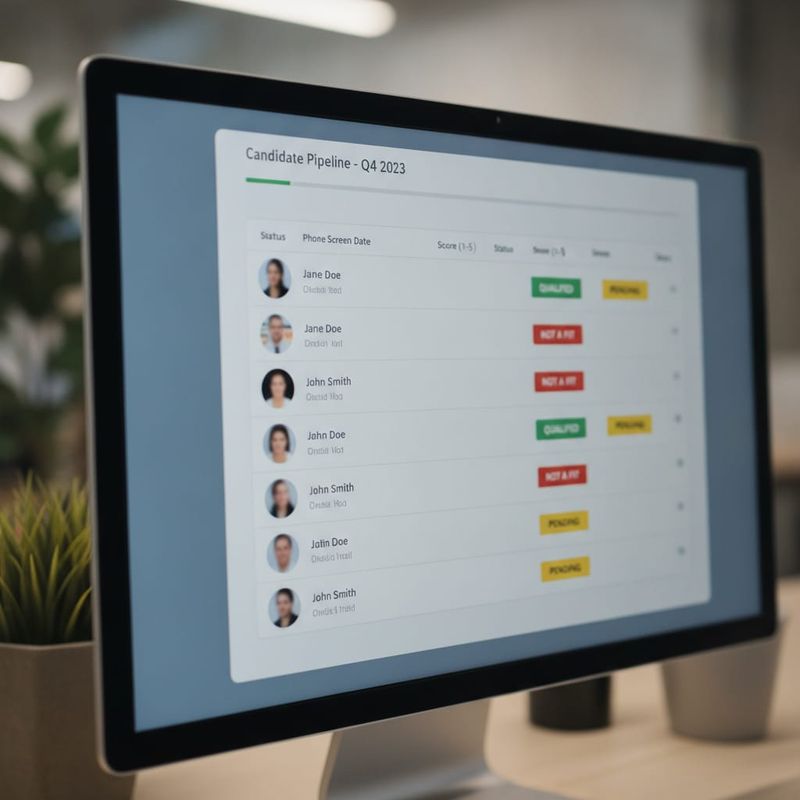
Every screen wrote straight back to the recruiting system: a pass or fail tag, the six captured answers, and a transcript. Recruiters opened their morning queue and saw a sorted shortlist instead of a list of phone numbers. The whole front line ran on Topcalls AI voice agents, which already process more than 63,000 calls a day across customers.
Want to see what calling every applicant within 5 minutes would do to your placement numbers? Run the math on our ROI calculator.
How much recruiter time did it save?
The agency got back about 22 hours of recruiter time a week, more than half a full desk. Before Topcalls, 14 recruiters spent roughly 90 minutes each per day on first-screen calls and the admin around them. That is about 158 hours a week of dialing, leaving voicemails, and typing notes. After the AI took the first screen, recruiters only talked to candidates who had already passed.
The time didn't just vanish, it moved. Recruiters spent the recovered hours on the parts of the job a machine can't do: prepping candidates for client interviews, negotiating offers, and chasing new job orders. One recruiting lead put it bluntly in a review: "I stopped being a dialer and started being a closer again."
Cost moved the same direction. At Topcalls' flat $0.35 a minute and a 4-minute average screen, each AI call landed around $1.40. A recruiter doing that same screen, counting salary, benefits, and the time lost to no-answers, runs many times that per completed conversation. The agency didn't cut headcount. It pointed the same 14 people at higher-value work.
None of this would have stuck without clean handoff. Because the screens synced through Topcalls CRM and ATS integrations, recruiters never re-keyed anything. The pass list, the answers, and the transcript were already in their system when they logged in.
What happened to candidate response rate?
Candidate response rate went from 31% to 58% in the first 60 days. The lift came from two things: speed and persistence. Topcalls called applicants within 5 minutes of their application instead of the next business day, and it retried every miss on a schedule instead of giving up after one voicemail. Reaching candidates while they were still actively looking nearly doubled the share who picked up and engaged.
Speed-to-lead is well documented. A Harvard Business Review analysis of 2,241 US companies found the average first-response time to a web lead was 42 hours, and that firms responding within an hour were far more likely to have a meaningful conversation. Staffing candidates are even more time-sensitive than B2B buyers, because a strong applicant is fielding offers from three agencies at once.

The result of a higher response rate was a fuller, cleaner shortlist. With 58% of applicants reached and screened against the same six criteria, recruiters opened a pipeline of pre-qualified people every morning instead of a backlog of unknowns. Time-to-shortlist fell from 6 days to 1, and the agency started filling reqs its clients used to give to a competitor.
Here is the before and after across the metrics the agency tracked.
| Metric | Before (manual) | After (AI screening) |
|---|---|---|
| Phone screens per day | 60 | 400 |
| Candidate response rate | 31% | 58% |
| Time to shortlist | 6 days | 1 day |
| Recruiter hours on first screens | 158 hrs/week | 136 hrs/week freed |
| Cost per completed screen | Recruiter loaded time | ~$1.40 at $0.35/min |
What's the takeaway for other agencies?
The lesson is that the first screen is the cheapest thing to automate and the most expensive thing to leave manual. This agency didn't reinvent recruiting. It moved six routine questions off 14 people's plates, called every applicant in 5 minutes instead of a day, and let humans spend their time where judgment actually matters. Volume went up 6.6x, response rate nearly doubled, and nobody lost a job.
Where it doesn't fit: AI screening earns its keep on high-volume, criteria-based roles, light industrial, admin, call center, retail, healthcare support. For a $250k executive search where every conversation is relationship-building and nuance, an AI first call is the wrong tool. The win is at the top of the funnel, where the work is repetitive and the speed penalty is brutal, not at the close.
If you run a staffing desk and your recruiters are still dialing through a backlog, start with one req type and one screen. For the mechanics of how this works across a staffing operation, see our guide on AI voice agents for staffing agencies, and if no-shows at the interview stage are your problem, look at AI appointment setting to confirm and remind candidates automatically.
Six days of waiting cost this agency the candidates it wanted most. One day didn't. If you want to see your own screening numbers run the same way, book a strategy call and we'll map your first req type together.
Get AI calling tips in your inbox
No spam. One email per week with actionable sales automation tips.