A dormant trader picks up, hears a voice say the name of your brokerage, and asks "who is this?" Then waits. AI voice latency on outbound calls is that wait: the gap between the trader's last word and the AI's first, and once it stretches past about a second the call is usually over before the offer is made.
Vendors quote a latency number on a slide. The number that counts is the one you measure yourself, from a mobile phone in a market you actually call, with the CRM lookup switched on and the compliance wording loaded into the prompt. This guide puts figures on the gap, shows where the milliseconds come from on a broker call, and gives you six tests to run against any vendor before you sign.
Key Takeaways
- People hand over the conversational turn about 208 milliseconds after the other speaker stops, on average across 10 languages, according to Stivers and colleagues in PNAS (2009).
- ITU-T Recommendation G.114 puts "transparent interactivity" below 150 milliseconds of one-way delay and sets 400 milliseconds as the limit for general network planning.
- Topcalls responds in real time, even with a phone network and an AI pipeline both sitting in the path.
- A mid-call CRM lookup for balance, KYC status or last trade date adds its own delay on top of the voice pipeline, so test with live data, never with a demo script.
- Twilio's call-quality documentation scores every call with MOS on a 0 to 5 scale and treats anything above 4 as acceptable; ask your vendor for the same per-call metric before you sign.
1. What is AI voice latency on outbound calls?
AI voice latency on an outbound call is the time between a trader finishing a sentence and hearing the AI's reply, measured mouth to ear. It adds up speech recognition, the language model's thinking time, text-to-speech, and the phone network in both directions. Vendors tend to quote only the middle piece. Buyers should count all of it, from a real handset, in the country the traders live in.
Network engineers have measured voice delay for decades, and their standard is worth knowing because it describes only part of your problem. ITU-T G.114 is about one-way transmission time across the phone network. An AI call pays that delay twice per turn, once for the trader's speech to reach the model and once for the reply to come back, and then adds processing on top.
The reason latency matters more on a reactivation call than on a KYC reminder is the number of turns. A trader who's been inactive for six months asks questions: is my account still open, do I need to send documents again, what's the spread on gold today, why are you calling from this number. Every one of those exchanges pays the full gap again. Thirty turns at 1.5 seconds is 45 seconds of dead air in a five-minute call.
2. How much delay does a trader actually notice?
Stivers and colleagues measured a mean gap of 208 milliseconds between turns across 10 languages in PNAS in 2009, with every language within about 250 milliseconds of that mean. ITU-T G.114 sets 150 milliseconds as the point below which a call feels fully interactive and 400 milliseconds as the planning ceiling. For an AI over a phone line, under 500 milliseconds end to end is the realistic target.
The ITU wording is precise. Below 150 milliseconds, "most applications, both speech and non-speech" experience what the recommendation calls "transparent interactivity". The same document says a one-way delay of 400 milliseconds "should not be exceeded for general network planning". Software can't hit either number once a language model sits in the loop, which is why sub-500 is the honest benchmark.
The PNAS data has a detail multilingual brokers should keep. Danish speakers left the longest average gap at 469 milliseconds and Japanese speakers the shortest at 7 milliseconds. A Tokyo trader hears a half-second pause as a machine faster than a Copenhagen trader does. If you run one AI across a Japanese list and a Scandinavian list, the same latency lands very differently.
A dormant trader is already suspicious when the phone rings. A 1.5-second pause after "who is this?" sounds exactly like a call-centre dialer connecting an agent, which is the experience that trained them to stop picking up in the first place. Natural AI voice and interruption handling matter, but neither survives a slow reply gap.
3. Where do the milliseconds come from on a broker call?
On a brokerage AI call, delay stacks up in five places: the phone network, speech-to-text, the language model, text-to-speech, and any data lookup the AI runs mid-sentence. Cisco's delay budget for packet voice alone counts coder delay, 20 to 30 milliseconds of packetization, a de-jitter buffer and network switching before a single word reaches the AI. The pipeline sits on top of all of that.
| Stage | What adds delay | What the buyer controls |
|---|---|---|
| Phone network | Codec, packetization, jitter buffer, international routing to the trader | Carrier choice per market; test from the country you call |
| Speech-to-text | How long the system waits to decide the trader has stopped talking | Ask whether turn detection is silence-based or semantic |
| Language model | Model size plus the length of the prompt, including compliance wording | Keep the disclosure, trim everything else; measure time to first word |
| Text-to-speech | Whether audio streams as it's generated or waits for the full sentence | Insist on streaming; listen for a pause before long answers |
| CRM or platform lookup | Balance, KYC status, last trade date fetched during the call | Test with live data; the AI should acknowledge while it waits |
Turn detection deserves its own line because it's invisible on a slide. The OpenAI Realtime documentation describes two modes: server VAD, the default, which uses periods of silence to decide the trader has finished, and semantic VAD, which uses a classifier on the words themselves. Silence-based detection has to wait out the pause before it can act, so a longer silence setting means a slower reply on every turn, and a shorter one means the AI talks over traders who pause mid-thought.

Your compliance desk will want the disclosure, the risk warning and the do-not-advise rules in the prompt. Keep them. But every extra page of instruction is extra time to first word, so measure the prompt you'll actually ship, not the vendor's clean demo. The same goes for CRM and trading-platform connections: an account-status check that takes two seconds turns a fast AI into a slow one at the exact moment the trader is deciding whether to stay on the line.
4. Which latency tests should a brokerage run before signing?
Run six tests, all from a real mobile phone in a market you call, and write the numbers down. Time the reply gap on a simple question, interrupt the opening line, ask something that forces a CRM lookup, ask for a long answer, run 20 calls back to back and keep the slowest, and dial through the international route your traders sit on. A vendor demo on a laptop headset tells you nothing.
| Test | How you run it | Pass mark |
|---|---|---|
| Simple reply gap | Ask "which broker is this?" and time the silence with a stopwatch app | Under 500 milliseconds, consistently |
| Interruption | Cut in three words into the opening line | AI stops within a beat and answers the interruption |
| Data lookup | Ask "is my account still active?" with the CRM connected | AI acknowledges immediately, answer arrives within two seconds |
| Long answer | Ask "what changed on the platform since last year?" | Speech starts fast and streams; no long pause before a monologue |
| Consistency | 20 calls in a row, record the slowest reply on each | The slowest fifth still under about a second |
| Market route | Dial from the UAE, Poland, South Africa or wherever your book is | No audible difference from the vendor's home market |
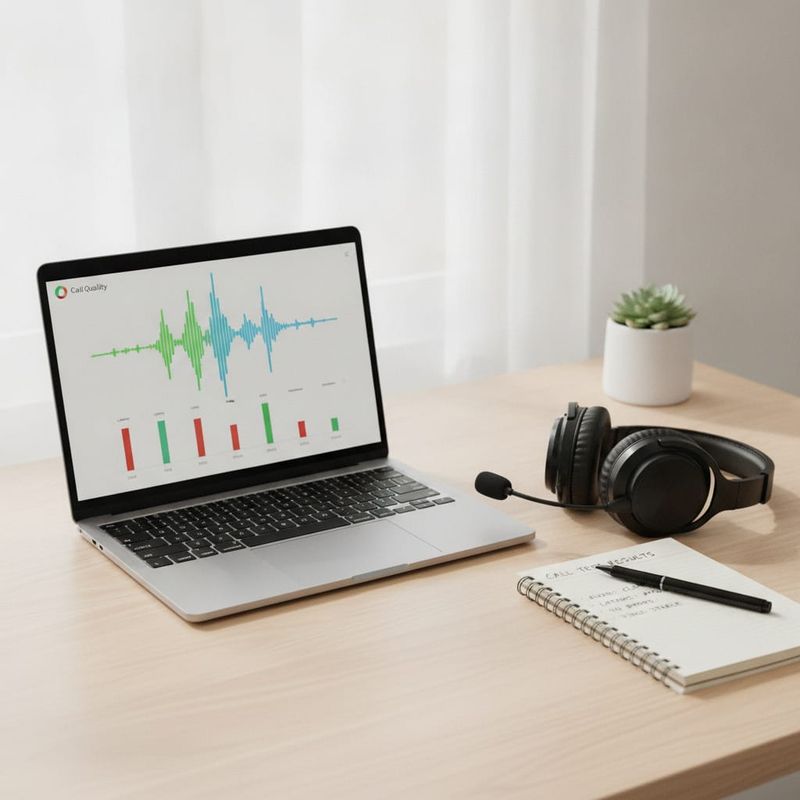
Ask for the 95th percentile, not the average. An average of 400 milliseconds with a tail at two seconds means one call in twenty goes badly, and on a 10,000-account list that's 500 traders who hear a robot. Vendors that report per-call quality in a real-time analytics dashboard make this easy; vendors that report a single average are hiding the tail.
Ask for the network metrics too. Twilio's call-quality documentation defines round-trip time as the milliseconds for packets to travel from its gateway to the device and scores MOS on a 0 to 5 scale, where anything above 4 counts as acceptable. Those are the same figures your telephony layer reports, whoever supplies it. Put the six tests into the vendor question list and repeat them in your ongoing QA after launch, because carriers change routes without telling anyone.
5. What does slow AI voice cost a reactivation campaign?
Latency costs a brokerage twice: in calls that end before the offer is made, and in billed minutes spent on silence. Topcalls charges $0.35 per minute all-inclusive, so cost per real conversation depends on how many dials turn into conversations. A trader who hangs up on a two-second pause still cost the dial and the first 20 seconds. The dormant trader revenue calculator puts your own book size on it.
Silence is billed like speech. Take 5,000 connected calls with 30 turns each. At 1.5 seconds per gap that's 45 seconds of dead air per call, about 62 hours across the campaign. At 0.4 seconds it's 12 seconds per call, about 17 hours. At $0.35 a minute the difference is roughly $1,300 versus $350 of paid silence, before counting a single trader who hung up.
The hang-ups are the bigger number and the harder one to see. They show up as short calls with no disposition, which a campaign dashboard will flag if you look at call length by outcome. Brokers running customer reactivation at scale should compare the share of calls under 15 seconds between vendors during the pilot; drop rates on outbound AI calls are usually a latency story dressed up as a list-quality story.
6. How does Topcalls handle latency on brokerage calls?
Topcalls runs outbound calls with real-time responses, handles 63,000+ AI calls a day and holds 99.9% uptime, with the voice model, telephony, recording, transcription and analytics all inside the $0.35 per minute rate. Brokers hear it on a live call during a strategy session, get a proposal within 48 hours, and can have a campaign live in about two weeks.
The six tests above are the ones we'd rather you run on us than take our word for. Bring your broker name, 20 instrument tickers and your compliance wording to a 30-minute call, dial the AI voice agent from your own phone, and time it. Topcalls speaks up to 78 languages, so the same test works for a Warsaw list and a Dubai list, and a first campaign usually goes live in about 2 weeks.
If you want to see how latency plays into a full campaign rather than a single call, the guide to reactivating dormant trading accounts with AI voice agents covers list selection, timing and handoff. Or skip the reading and book a 30-minute call to hear it.
7. When doesn't latency testing matter?
Latency testing is wasted effort in four cases: one-way calls, tiny lists, channels other than voice, and campaigns that haven't cleared compliance yet. If nobody on the other end is waiting for a reply, the reply gap is irrelevant. If the list is a few hundred accounts, two people can work it in a week without an AI. And no latency number fixes a consent problem.
- One-way notifications: a KYC document reminder that leaves a message, a margin call notice, a voicemail drop. Nobody waits on a reply, so test the audio quality and the disclosure, not the gap.
- Lists under a few hundred accounts: the economics of an AI at $0.35 per minute start to matter at thousands of dormant accounts across several languages and time zones, not at 300 accounts in one country.
- SMS or email-only markets: where your compliance desk permits written contact but not outbound calls to dormant accounts, the voice pipeline never runs.
- Consent not sorted: if the do-not-call screen, the marketing consent flag and the recording notice aren't in place for a jurisdiction, fix those first. A fast robot calling the wrong people is still calling the wrong people.
Half a second decides the call. Measure it from a phone, with your prompt and your data connected, before anyone signs anything.
Frequently Asked Questions
Get AI calling tips in your inbox
No spam. One email per week with actionable sales automation tips.