
A dormant trader gives your call about three seconds before deciding whether it gets a fourth. A natural AI voice for forex calls is what earns that fourth second, and a robotic one is what gets the call ended, the number blocked and, on a bad day, reported to your regulator. Brokers pay for the list, the offer and the compliance review, then lose the call in the first breath because the voice paused too long or mangled "EUR/USD".
This guide puts numbers on what "natural" means, explains why traders react to a synthetic voice the way they do, shows where the difference lands in a reactivation campaign, and gives you five tests to run on any vendor before you sign.
Key Takeaways
- People hand over the conversational turn in about 208 milliseconds on average across 10 languages, according to a 2009 PNAS study, so a two-second AI pause is heard as a machine by every trader on the planet.
- ITU-T Recommendation G.114 says one-way delay should not exceed 400 milliseconds for network planning, and delays under 150 milliseconds leave most voice applications feeling fully interactive.
- Topcalls replies in real time and speaks up to 78 languages, so a trader in Madrid, Dubai or Ho Chi Minh City hears a normal-paced voice in their own language.
- The FCC confirmed on February 8, 2024 that calls made with AI-generated voices are "artificial" under the TCPA, so a natural-sounding voice never loosens the consent rules.
- From 2 August 2026, Article 50 of the EU AI Act requires that people are informed they're interacting with an AI system, unless that is obvious from context.
- Topcalls prices every call at $0.35 per minute all-inclusive, so voice quality shows up in your connect and conversation rates, not on a premium invoice.
1. What Makes an AI Voice Sound Natural on a Forex Call?
A natural AI voice for forex calls does four things a trader notices without naming them. It replies within about half a second. It stops talking when the trader cuts in. It pronounces MT5, EUR/USD, "swap-free account" and your broker's name the way a colleague would. And it moves its pitch and pace like a person who's actually listening. Miss one and the trader's brain files the call under "machine".
Timing comes first because it's the thing people are worst at ignoring. Stivers and colleagues measured turn-taking in 10 languages across five continents and found a cross-language mean gap of about 208 milliseconds between one speaker finishing and the next starting, with every language landing within roughly 250 milliseconds of that figure. The study is open access at PNAS via PubMed Central. Software won't hit 200 milliseconds over a phone line. But the tolerance has a ceiling, and traders hear it being crossed.
Telephony engineers have had a number for that ceiling for years. ITU-T Recommendation G.114 advises that a one-way delay of 400 milliseconds should not be exceeded for general network planning, and notes that delays kept below 150 milliseconds leave most applications feeling fully interactive. Topcalls responds in real time, including the model's thinking time. The AI voice latency post in this series explains how to measure that on your own line rather than trusting a demo recording.
Pronunciation is the forex-specific trap. A generic voice model will read "MT5" as a single word, stress the wrong syllable in "Exness" or "Pepperstone", and say "pips" like a fruit. Traders forgive a human agent who's new. They don't forgive a voice that obviously doesn't know the product, because that's exactly what a scam call sounds like. Where pronunciation breaks inside the model is covered in how AI voice agents work.

Prosody is the last piece, and the hardest to fake. A real account manager says the trader's name once, drops their pitch at the end of a statement, lifts it on a question, and speeds up on the boring bit about opening hours. A flat delivery reads as a script even when the words are good. Topcalls runs on a voice agent stack built around the live turn, so the reply is generated for what the trader just said, not pulled from a bank of pre-recorded lines.
2. Why Do Dormant Traders Hang Up on Robotic Voices?
Because dormant traders have already been called by every boiler room with a dialer. A flat voice with a two-second lag matches the pattern they learned to hang up on years ago, and a trader who left your platform after a losing month has no reason to give a machine a second chance. The voice is the first trust signal, ahead of the offer and ahead of your broker's name.
Traders go quiet after a drawdown, after a KYC request they never finished, after a failed card deposit, or after they moved their capital to a competitor with a tighter spread. A reactivation call lands on a bad memory. If the first thing the trader hears is a synthetic voice that steamrolls their "sorry, who is this?", the memory gets worse and the number goes on their personal blocklist.
Interruption handling is where robotic voices fail loudest. A trader says "I'm not interested" three words into the pitch and the AI keeps reading the paragraph. A natural voice stops mid-sentence, acknowledges what was said, and either answers the objection or ends the call politely. The interruption handling post in this series goes through the failure modes one by one.
Accent matters more in this industry than in most, because brokerages are global by default. A trader in Lagos hearing a Californian voice, or a trader in Warsaw hearing a British one, immediately wonders which offshore entity is calling. Topcalls covers up to 78 languages through its multi-language support, and the voice and accent selection guide explains how to pick one per market rather than one per campaign.
The commercial effect is measurable at the top of the funnel. Topcalls reports a connect-rate lift of 60% or more on its campaigns, and the connect rate is only the start: a trader who stays past the greeting is a trader who can be asked about a callback, a deposit or an unfinished document.
3. How Does Natural AI Voice Change Reactivation Results?
A natural voice changes the shape of the whole funnel, and the effect is measurable. The differences show up in three numbers your campaign dashboard already tracks: how many answered calls last past 20 seconds, how many traders agree to a next step such as a callback, a deposit link or a KYC upload, and how many ask for a human. Each moves when the voice stops sounding like a recording.
Start with conversation length. A hang-up at 15 seconds costs you about $0.09 at Topcalls' $0.35 per minute, which sounds cheap until you count the contact attempt you just burned on a trader you can only call so many times before the consent runs out. A full two-minute conversation costs $0.70 and gives the AI room to ask about the real reason the account went quiet. The list contact is the expensive part.
Then look at accepted next steps. A dormant trader call rarely closes on the phone; its job is a small yes: a callback with a named account manager on Thursday, a link to finish the deposit, a reminder that the proof-of-address document is still missing. A voice that sounds like it's listening gets more of those small yeses, and the small yeses are what a customer reactivation campaign is built on.
Finally, watch the handoff rate. Traders who ask for a person are a good sign, as long as the AI recognises the request and routes it. A robotic voice gets fewer handoff requests because traders just leave. Topcalls handles more than 63,000 AI calls a day, and the campaigns that perform best are the ones where the human desk sits behind the AI for exactly these moments. The dormant trading account reactivation post shows what that split looks like in practice.
If you want to see what those three numbers are worth on your own book, the dormant trader revenue calculator takes your dormant account count, average deposit and reactivation rate and puts a monthly figure on it. Brokers who want the call to sound like their own team can also put a real account manager's voice on the line through voice cloning.
4. What Should a Broker Test Before Choosing an AI Voice?
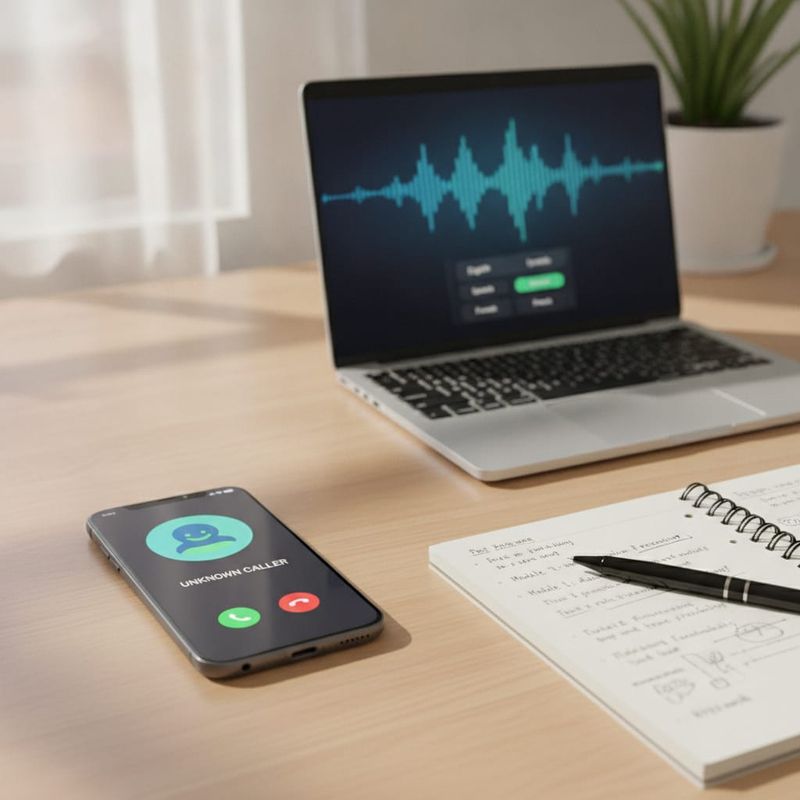
Run five tests on a live call, never on a demo recording: time the reply gap, interrupt the AI mid-sentence, feed it 20 forex terms plus your broker name, dial from each target market and listen to the accent, and ask "are you a robot?" to hear the disclosure. Score each pass or fail. A vendor that won't let you run these tests is telling you something.
| Test | What you do | Pass mark |
|---|---|---|
| Reply gap | Ask a question and time the silence before the AI answers | Under 500 milliseconds, consistently, over a real phone line |
| Interruption | Cut in with "who is this?" three words into the opening line | The AI stops, answers, and picks up where it makes sense |
| Pronunciation | Send 20 terms: MT4, MT5, EUR/USD, pips, spread, swap-free, your broker name | All 20 said the way your own desk says them |
| Accent per market | Dial from Spain, the UAE, Poland and Vietnam | A local voice in each, not one accent with translated words |
| Disclosure | Ask "am I talking to a machine?" | A clear yes, in the trader's language, without breaking the tone |
Run the tests on a mobile number in the target country, because the codec and the carrier hop add delay a laptop demo never shows. And run them in the languages you'll use, since a voice that sounds fine in English can fall apart on Polish consonants or Arabic vowel length.
Setup shouldn't be the reason you skip the tests. Topcalls usually gets a first campaign live in about two weeks with managed setup, with a proposal sent within 48 hours of the strategy call. You can book a 30-minute call and run all five tests during it, with your own instrument list and your own broker name.
5. Does a Natural Voice Change Compliance Obligations?
No, and in one direction it adds to them. A more human-sounding AI voice doesn't loosen consent rules. The FCC confirmed on February 8, 2024 that calls made with AI-generated voices are "artificial" under the TCPA, and from 2 August 2026 Article 50 of the EU AI Act requires that people are informed they're interacting with an AI system. Natural should never mean deceptive.
The US position is unambiguous. In its February 8, 2024 announcement, the FCC said the Declaratory Ruling "recognizes calls made with AI-generated voices are 'artificial' under the Telephone Consumer Protection Act" and takes effect immediately. FCC Chairwoman Jessica Rosenworcel put the reasoning plainly: "Bad actors are using AI-generated voices in unsolicited robocalls to extort vulnerable family members, imitate celebrities, and misinform voters. We're putting the fraudsters behind these robocalls on notice." For a brokerage calling US numbers, the same consent standard applies as for any artificial or prerecorded voice, however natural the AI sounds.
The EU position arrives on a fixed date. Article 50(1) of the EU AI Act requires that AI systems meant to interact directly with people are built so that "the natural persons concerned are informed that they are interacting with an AI system", with an exception where that's obvious to a reasonably well-informed person. Article 50 applies from 2 August 2026. Don't lean on the exception: a voice good enough to pass your five tests is, by definition, not obviously artificial.
The practical answer is a disclosure in the opening line that doesn't kill the tone. "Hi Maria, this is the AI assistant from [broker], calling about your trading account" takes three seconds and satisfies both rules. Most traders don't mind; what they mind is finding out later. The AI call disclosure post lists the questions your compliance desk should answer before the first campaign, and Topcalls includes recording and transcription in the per-minute price rather than selling them as an add-on.
6. When Doesn't Natural AI Voice Matter?
Voice quality stops being the lever when the call itself is the wrong tool. Complaints, margin-call disputes, anything that touches regulated investment advice, and top-tier accounts with a named relationship manager should stay with humans no matter how good the AI sounds. And in markets where your legal team hasn't cleared AI outbound calls at all, the voice question is moot.
- Disputes and complaints: a trader calling about a slippage claim or a frozen withdrawal wants a person with authority, and an AI voice, however natural, reads as the broker hiding.
- Advice-adjacent conversations: if the call could drift into what to trade or when, keep it on a licensed human. A natural voice makes the drift more likely, not less.
- High-value relationships: accounts with six-figure balances and a named manager should hear that manager. Use the AI for the long tail of the dormant book instead.
- Uncleared markets: if your compliance desk hasn't signed off AI outbound for a jurisdiction, the choice of voice doesn't help. Sort the consent and disclosure basis first.
- Tiny lists: a few hundred dormant accounts can be called by two people in a week. The economics of an AI voice start to matter at thousands of accounts and several languages.
Everywhere else on the dormant book, the voice is the difference between a contact and a conversation. Get the reply gap under half a second, get the pronunciation right, disclose up front, and let the human desk take the calls that earn a human.
Frequently Asked Questions
Get AI calling tips in your inbox
No spam. One email per week with actionable sales automation tips.