
A dormant trader list at a mid-sized CFD broker rarely sits in one country. Cross-border AI calling compliance for brokers starts from that fact: the rules follow the trader's phone number, not the broker's licence, so an export with +1, +44 and +49 prefixes is three campaigns wearing one CSV. Get the split wrong and the opening line that's fine in Manchester becomes a consent problem in Miami.
This guide walks the compliance desk and the retention lead through the planning work before an AI voice agent dials across borders. Grouping by country code. Checking whether your licensed entity may solicit there at all. Matching consent rules, do-not-call registries and calling windows per market. Deciding what the agent says in each country and where the recordings end up. Each step maps to a line in the planning checklist linked below.
Key Takeaways
- On 8 February 2024 the FCC ruled that AI-generated voices are "artificial" under the TCPA, so a marketing call to a US number carries the prior express written consent standard.
- US telemarketing rules limit solicitations to 8 a.m. to 9 p.m. in the called party's local time and require a National Do-Not-Call Registry version no more than 31 days old.
- UK PECR Regulation 21 protects numbers on the TPS register once they've been listed for 28 days, and Regulation 19 requires prior consent for marketing calls from automated systems that play recorded sound.
- ESMA's CFD measures, in force since 1 August 2018, prohibit incentives to trade CFDs for retail investors, which removes deposit bonuses from EU reactivation scripts.
- Topcalls agents speak up to 78 languages at $0.35/min all-inclusive, so a localised voice per country costs the same per minute as a single-market campaign.
- Run one country per pilot: live campaigns typically start within about two weeks, and each added jurisdiction adds a sign-off row, not a new platform.
1. Why Does Cross-Border AI Calling Compliance Follow the Trader, Not the Broker?
Because every telemarketing and data protection regime protects its own residents, not the companies calling them. A CySEC-licensed broker dialing a German client answers to German marketing rules and GDPR. The same broker dialing a Texan answers to the TCPA and Texas law, wherever the agent's server sits. Cross-border AI calling compliance for brokers is a per-country map, and a single global policy is the first mistake to avoid.
There's a second layer most retention teams skip. Before consent or calling hours matter, the question is whether your entity is allowed to market in that country at all. ESMA's product intervention measures on CFDs, which took effect on 1 August 2018, limited retail clients to 30:1 on major currency pairs, required a standardised risk warning with the percentage of losing retail accounts, and prohibited incentives to trade. Several national regulators went further. A reactivation call that offers a "welcome back" bonus to an EU retail trader is a product problem before it's a calling problem.
So the planning order is licence, then consent, then registry, then clock, then recording. Skip the first and the other four are wasted on a segment you'll suppress anyway.
2. Which Rules Change With Each Country Code?
Four things move: whether an automated voice needs specific consent, which do-not-call register applies and how often you refresh it, the permitted calling hours, and what the caller ID has to show. The US and the UK have written rules on all four. Most other markets have at least an opt-out register or an opt-in requirement, and your compliance officer has to name which one before the segment dials.
| Question | United States | United Kingdom | Other markets |
|---|---|---|---|
| Automated voice consent | Prior express written consent for artificial-voice marketing calls (47 CFR 64.1200) | Prior consent for recorded-sound automated calls (PECR Reg. 19); counsel decides if real-time AI counts | Opt-in or opt-out, set by national law; record which |
| Do-not-call register | National DNC Registry, version no more than 31 days old | TPS register, protected after 28 days on the list | Name the register, or note that none exists |
| Calling hours | 8 a.m. to 9 p.m., local time of the called party | Not fixed by Reg. 21; set by policy | Check statute, then set the scheduler |
| Caller ID | Callback number the trader can dial | CLI shown or a contactable number presented (Reg. 19 and 21) | Local number matched to the licensed entity |
The US column is the one that changed most recently. In its 8 February 2024 press release the FCC announced a Declaratory Ruling that calls made with AI-generated voices are "artificial" under the TCPA and are held to the same standards as prerecorded messages, including the prior express written consent requirement for telemarketing. The rule text at 47 CFR 64.1200 adds the 8 a.m. to 9 p.m. window and the 31-day registry refresh.
The UK column comes from two regulations. PECR Regulation 19 covers automated calling systems that transmit recorded sound and requires that the subscriber "has previously notified the caller that for the time being he consents". Regulation 21 bans unsolicited live marketing calls to anyone who told you to stop or who has been on the TPS register for 28 days or more, and requires you to show your calling line identity or a callback number. Our UK PECR compliance guide goes through both in detail.

3. How Should Brokers Segment a Dormant Trader List by Jurisdiction?
Group by the phone number's country code, not the CRM's country field. The E.164 prefix is the one fact you can trust on a five-year-old MT4 export, and it's what the regulator will use to decide whose resident you called. Count each group, then answer the licence, consent, registry and hours questions for that group alone. A segment that fails the licence question gets suppressed, not scheduled.
A worked example. A broker exports 18,000 dormant accounts from MT5: 9,400 UK, 3,100 Germany, 2,200 UAE, 1,900 South Africa and 1,400 US by prefix. The compliance officer confirms the entity can't solicit US residents, so that segment is dropped before anyone looks at consent. Four segments remain, with four sign-off rows and four opening lines.
- Licensed entity: Name which of your entities holds the client relationship for each segment. Consent collected by one entity may not carry to another, and caller ID has to match the entity that's calling.
- Consent basis: For each segment, pull the consent wording from the registration form version the trader actually saw. A yes/no flag in the CRM isn't evidence; the form text is.
- Registry scrub: Schedule the TPS scrub for UK numbers, the National DNC scrub for any US numbers that survived the licence check, and whichever national register applies elsewhere. Log the date and file version.
- Offer rules: Strip any incentive language from scripts aimed at EU and UK retail traders. The ESMA measures above make a bonus offer a regulatory issue, not a persuasion tactic.
- Internal opt-outs: Apply your own do-not-call list across every segment. A trader who unsubscribed from email in 2023 has told you something about phone calls too.
The AI calling compliance planning guide for forex brokers covers the single-country version of this process. Cross-border adds one loop per prefix and one signature per loop. The checklist behind the link below has a jurisdiction section with a fill-in table for country, licence status, DNC registry, calling hours and sign-off, plus the consent, TCPA, recording and retention sections that feed it.
4. What Should the AI Agent Say Differently in Each Country?
Four lines change per market: who's calling, that the voice is an AI agent, that the call may be recorded, and how to stop. The rest of the conversation can share one flow. The language changes too, and so does the outbound number. Topcalls agents run in up to 78 languages, so a German trader hears German from a German number, and the disclosure sentence is approved once per country, not improvised per call.
Put the disclosure in the first sentence. A trader in Munich who realises three exchanges in that they're talking to software will hang up, and a regulator reviewing the recording will notice the delay. The recording notice belongs in the same breath; one approved sentence covers every all-party consent rule on the list.
Both UK regulations above require the calling line identity to be visible or a contactable number to be presented. A local number matched to the licensed entity for that market also cuts the "who is this" complaints that land in the compliance inbox. Our page on multi-language support covers voice and accent selection per market, and the multilingual AI voice agents for global brokerages post goes deeper on choosing one.
Test the spoken opt-out in every language before launch, and check that the number is suppressed before the next dial attempt, not after a nightly sync.
5. How Do You Schedule AI Calls Across Time Zones and Calling Windows?
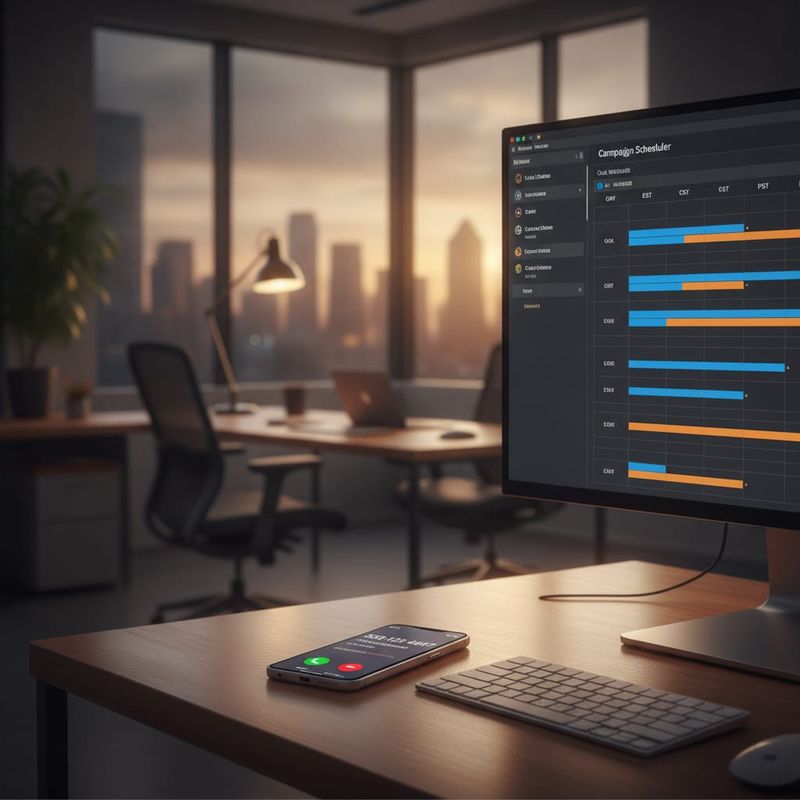
Derive the time zone from the phone number and let the campaign scheduler enforce each country's window on its own. US numbers get the 8 a.m. to 9 p.m. local-time rule from 47 CFR 64.1200, so the platform has to know that +1 305 is Eastern and +1 213 is Pacific. Markets without a statutory window still get one, set by your compliance officer and written into the campaign.
Retries are where cross-border campaigns leak. Three attempts spread over two days is a reasonable default in one country and a complaint pattern in another. Set the retry count and the gap per segment, and make the scheduler stop the moment a trader objects on any attempt. Smart Campaigns holds the window, retry rule and suppression list per campaign, which is why the four-segment example above becomes four campaigns rather than one campaign with four filters.
One more clock: the registry refresh. A US list scrubbed 31 days before launch is stale on launch day, so put the scrub date next to the launch date in the plan.
6. Where Do Recordings and Transcripts Live for Cross-Border Traders?
Wherever your data protection officer has confirmed they can live. A German trader's recording stored outside the EU is a GDPR transfer, and the DPO has to name the mechanism, whether that's an adequacy decision or standard contractual clauses. Recording and transcription are included in the $0.35/min rate, so the cost question is settled; the location, access and retention questions are the ones that need a written answer per country.
Build the answer as a table with three columns: where the trader lives, where the recording and transcript sit, and the transfer basis. Add the retention period as a fourth, because it varies by regime and by whether the call touched an order. The data retention guide for brokerage AI voice campaigns covers how to set that period; here you only confirm that the period is known per segment.
Ask the vendor where each piece of the pipeline runs and who its sub-processors are. Topcalls documents its secure infrastructure; TCPA, TSR, DNC and GDPR duties stay with you. Your DPO still signs the transfer analysis; the vendor's job is to hand over the map.
7. What Does a Cross-Border Reactivation Pilot Cost, and How Do You Sequence It?
At $0.35 per connected minute, all-inclusive, the calling cost of a cross-border pilot is arithmetic. A 3,000-number UK segment averaging three connected minutes is 9,000 minutes, or $3,150, with telephony, recording, transcription and analytics inside that figure. The compliance work is the real cost, and it scales with the number of jurisdictions, not the number of calls.
Start with the one country where licence, consent and registry answers are already clean. For most European brokers that's the UK or their home market. Run it, measure reactivations and deposits, then add the second jurisdiction with its own sign-off row; the campaign setup is copied and localised, not rebuilt. A first Topcalls campaign typically goes live within about two weeks.
To size the upside before you start, drop your dormant book and average deposit into the dormant trader revenue calculator. If the number justifies the compliance hours, book a 30-minute call and we'll return a proposal within 48 hours, with the jurisdictions you named as separate campaigns. The customer reactivation page shows how the segments, offers and handoffs are set up in practice.
If your licence allows US residents and you hold prior express written consent, the TCPA considerations for AI calls in financial services post covers the extra steps. If either condition fails, the US segment stays suppressed and the pilot is cheaper for it.
8. When Doesn't Cross-Border AI Calling Fit?
It doesn't fit when the licence question fails, when consent can't be evidenced per country, or when the segment is too small to justify its own sign-off. An AI agent makes the calling cheap; it doesn't make the compliance cheap. Some parts of a dormant book are better left to a retention manager with a phone and a script, or left alone.
- No licence to solicit: A regulator that bars foreign brokers from marketing to its residents ends the discussion. Suppress the segment and move on.
- Consent you can't produce: A CRM flag without the form wording behind it won't survive a complaint. Rebuild the consent trail first, or send an email inviting the trader to opt in to a call.
- Tiny segments: Forty dormant traders in a country with its own register, hours and recording rule aren't worth a sign-off row. A human callback list is cheaper.
- Order-handling calls: If the agent is likely to be asked about open positions, the call moves into MiFID II recording territory and a different review. Keep reactivation scripts on account status and next steps.
- Unresolved transfers: If the DPO can't name a transfer mechanism for a country, the recordings can't be stored, and the campaign can't run there yet.
Four questions per country, one signature per question, and the map is done. The agent only dials where every row is filled in.
Frequently Asked Questions
Get AI calling tips in your inbox
No spam. One email per week with actionable sales automation tips.