Your sales team dials 40 numbers a day. An AI voice agent dials 1,000, in 32 languages, and never asks for a lunch break. That is the short version of what changed on the phone in the last two years.
An AI voice agent is software that holds a real spoken phone conversation, no human on the line. It hears the caller, understands the words, decides what to say, and replies in a natural voice, fast enough that the back-and-forth feels normal. Topcalls runs more than 63,000 of these calls a day at $0.35 per minute. Below: how the tech actually works, what it costs, what it does well, and where it still falls short.
Key Takeaways
- An AI voice agent runs a four-stage loop on every turn: speech-to-text, a language model, text-to-speech, and a phone line tying them together.
- Humans expect a reply about 200ms after you stop talking (Stivers et al., PNAS 2009). Topcalls agents answer in under 500ms, so the call sounds live.
- Pricing is per minute. Topcalls charges $0.35/minute all-inclusive, so a two-minute qualifying call runs about $0.70.
- The global AI voice agents market hit $2.54 billion in 2025 and is forecast to grow 39% a year through 2033 (Grand View Research).
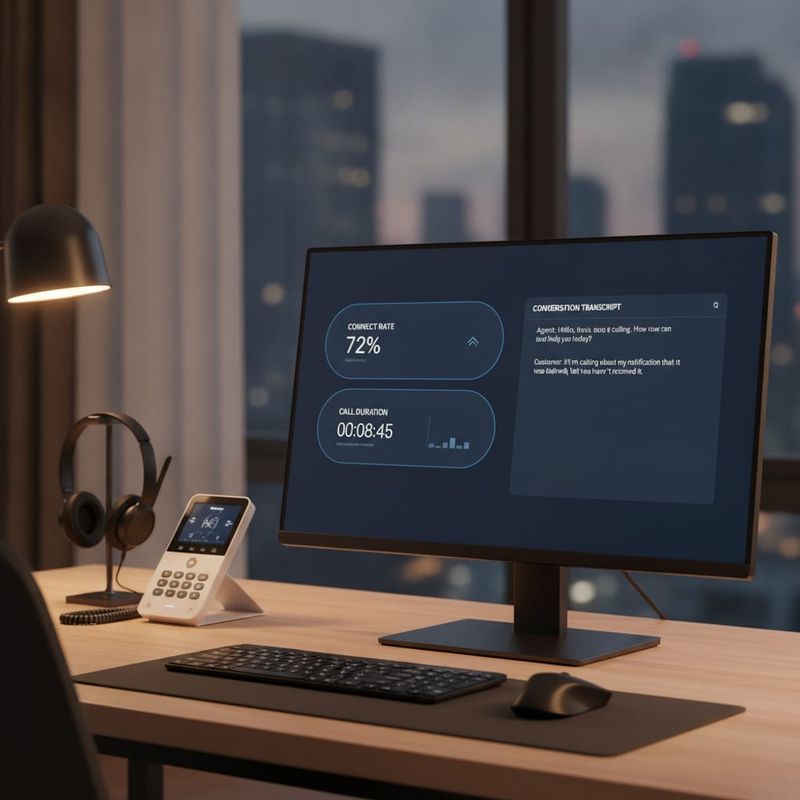
- Teams using AI voice agents for outbound report a 60%+ lift in connect rate, mostly from calling every lead within seconds instead of hours.
- Best fit: high-volume, repeatable calls like qualifying, booking, and follow-up. Worst fit: high-ticket deals that turn on deep relationship nuance.
What is an AI voice agent?
An AI voice agent is a software system that places or answers phone calls and carries on a spoken conversation on its own, with no person speaking on the company's side. It works from a goal you set, like qualifying a lead or booking an appointment, follows a script as a guide, improvises around it, and logs the result to your CRM when the call ends.
Think of it as three jobs a human caller does, handed to machines. The agent listens, decides what to say next based on the conversation so far, and speaks. It does this on a live phone line, turn after turn, until the call reaches its goal or ends.

This is not a recorded message or a robocall. A robocall plays the same audio at everyone. An AI voice agent reacts to what the specific person says, answers their actual question, and changes course mid-call. The whole point is that it sounds like a conversation, because it is one.
How does an AI voice agent work?
An AI voice agent runs a four-part loop on every turn of the call. Speech-to-text converts what the caller said into words. A language model reads those words plus the conversation history and writes the reply. Text-to-speech turns that reply into a spoken voice. A telephony layer carries the audio both ways. The loop repeats every time the caller stops talking, and speed is everything: people expect an answer about 200 milliseconds after you finish speaking.
Here is the loop broken out:
- Speech-to-text (STT): transcribes the caller's words in real time, streaming partial results so the agent does not wait for a full sentence to start thinking.
- Language model (LLM): reads the transcript and the goal, then decides the next line. This is the brain. It handles objections, answers off-script questions, and knows when to offer a calendar slot.
- Text-to-speech (TTS): speaks the reply in a chosen voice, with natural rhythm and pauses, so it does not sound flat or robotic.
- Telephony and turn-taking: dials the number, manages the audio stream, and detects when the caller is done speaking or interrupts. Topcalls runs this whole loop in under 500ms per turn.
Latency is the difference between a call that flows and one that feels broken. Turn-taking research published in PNAS found the gap between speakers in natural conversation peaks around 200ms across every language studied, from English to Japanese. Cross that by too much and the caller senses something is off. That is why response speed, not voice prettiness, is the metric that decides whether the agent passes.
Want the full pipeline in detail? Our AI voice agents product page walks through the speech, reasoning, and voice layers end to end.
What can an AI voice agent do?
An AI voice agent handles repeatable phone work end to end: it qualifies inbound and outbound leads, books and confirms appointments, follows up on no-shows, and re-engages dormant accounts. It updates the CRM in real time and hands off to a human the moment a call needs one. Topcalls teams running outbound this way see a 60%+ improvement in connect rate, mostly from speed of response. See AI lead qualification for the BANT-by-phone workflow.
The jobs that pay off fastest:
- Speed-to-lead callbacks: calls a new web lead within seconds, when interest is still warm, instead of hours later when it has gone cold.
- Appointment booking: checks a live calendar, offers open times, confirms, and sends reminders, all inside one call.
- Qualification: asks budget, authority, need, and timeline questions, scores the lead, and routes only the good ones to a rep.
- Follow-up and win-back: chases the 80% of deals that need five or more touchpoints, and reopens accounts that went quiet months ago.
It also speaks the customer's language. Topcalls supports 32 languages with native-sounding accents, so one campaign can run a Spanish lead in Madrid and an English lead in Denver back to back. Our guide to multilingual AI voice agents covers how language selection works per call.
Curious what this does to your numbers? Run your own figures through our ROI calculator for missed calls, slow response, and dead leads.
How much does an AI voice agent cost?
Most AI voice agents are billed per minute of talk time, and the range runs roughly $0.05 to $0.60 a minute depending on what is bundled in. Topcalls charges $0.35 per minute all-inclusive, covering the voice model, telephony, and transcription in one number, with no per-seat license. A two-minute qualifying call costs about $0.70. That economics is part of why the AI voice agents market reached $2.54 billion in 2025 and is forecast to grow 39% a year.
The trap is in what the headline rate leaves out. A platform that quotes $0.10 a minute but charges separately for the LLM, the telephony carrier, the transcription, and a monthly seat fee often lands higher than an all-inclusive $0.35. Read the line items before you compare.
| Cost model | What you pay | Watch for |
|---|---|---|
| All-inclusive per minute | $0.35/min (Topcalls) | Nothing hidden; voice, telephony, transcription bundled |
| Metered add-ons | $0.10/min base + fees | LLM, carrier, and transcription billed on top |
| Per-seat license | $200-$1,500/seat/mo | Caps how many agents run at once |
| Human SDR (reference) | $5,000-$8,000/mo loaded | Limited to ~40-80 dials a day |

For a line-by-line breakdown of where the dollars go, see our AI voice agent cost guide. And because the marginal cost of one more call is near zero, running thousands at once through smart campaigns costs the same per minute as running ten.
Where do AI voice agents fall short?
AI voice agents are strong at high-volume, repeatable calls and weak at deals that hinge on a relationship. A complex six-figure enterprise negotiation, a delicate retention save with an angry long-time customer, or a sale that turns on reading a room: those still belong to a human. The right model is AI for the first 80% of dials, a person for the conversations where nuance decides the outcome.
Three honest limits worth naming:
- Deep emotional nuance: an agent handles objections well, but it will not out-empathize a skilled human on a hard, personal call.
- Truly novel situations: if a caller goes somewhere the script and goal never anticipated, a clean human handoff beats a forced answer.
- Compliance is on you: AI does not exempt you from consent rules, do-not-call scrubbing, or AI-disclosure laws. The platform helps, but the campaign owner is still responsible.
On that last point, Topcalls runs TCPA, TSR, and GDPR compliant campaigns and keeps call data encrypted, which our secure infrastructure page details. Naming where the tool stops is the honest way to scope it, and it is usually a narrower slice than the hype suggests.
Is an AI voice agent right for your team?
If your team makes the same call hundreds of times a week, an AI voice agent will pay back quickly. Most Topcalls customers go live in about 15 minutes of setup and have a full campaign running within two weeks. The clearest wins are appointment setting, lead qualification, and follow-up, where volume is high and the script is stable.
A simple test: count how many of your weekly calls follow the same shape. If it is most of them, you are leaving connect rate and revenue on the table by routing them through people who can each only dial 40 to 80 numbers a day. If it is a handful of bespoke, high-stakes conversations, keep them human.
Want to see one run your own script before you commit? Book a strategy call and we will set up a live agent on a sample of your leads.
Frequently Asked Questions
Get AI calling tips in your inbox
No spam. One email per week with actionable sales automation tips.