Most brokerages can't say what a reactivation call costs them, let alone what it brings back. AI calling ROI for brokers comes down to four numbers: the price per minute, the minutes per dial, the reactivation rate, and what a reactivated trader is worth over the next 90 days. Get those four and the break-even falls out in one line of arithmetic. This guide builds that model for a forex or CFD desk, with Topcalls at $0.35 per minute on the cost side and your own deposit history on the revenue side, so you can decide before you dial a single dormant account.
Key Takeaways
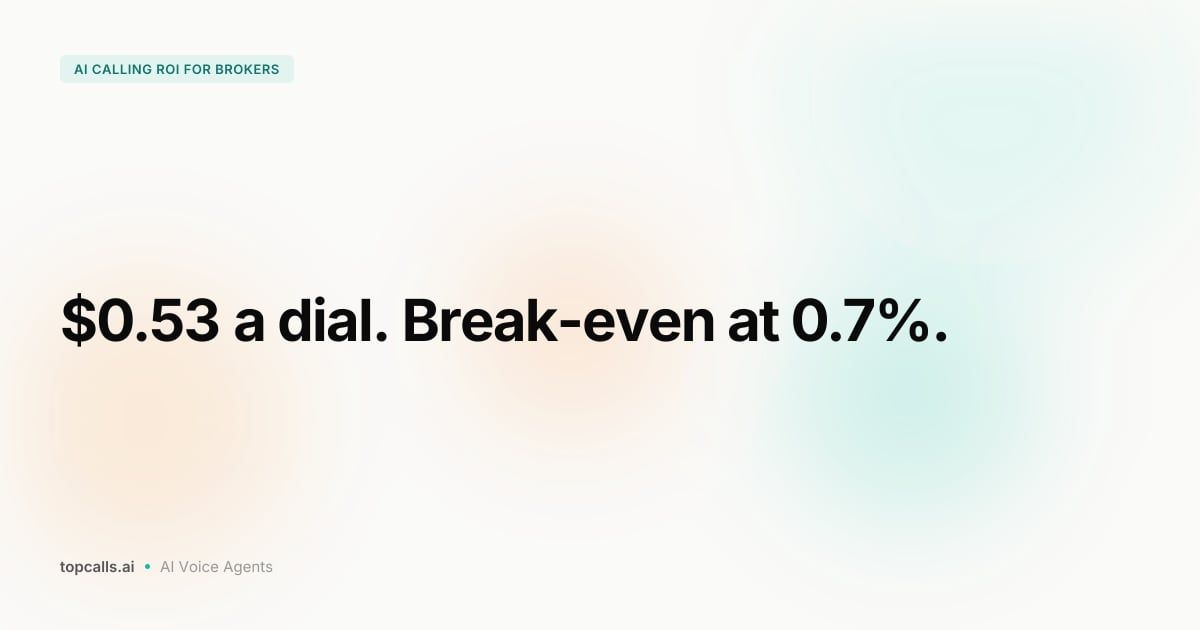
- Topcalls charges $0.35 per minute all-inclusive, so a dormant trader dial averaging 1.5 minutes costs about $0.53 for voice model, telephony, recording and transcription combined.
- Break-even reactivation rate equals campaign cost divided by list size times value per reactivated trader; on 5,000 accounts at $150 each, that is 0.7%.
- The US Bureau of Labor Statistics put the median customer service wage at $21.53 an hour in May 2025, before benefits, dialer seats or a team lead.
- ESMA found 74% to 89% of retail CFD accounts lose money, so a broker should value a reactivated trader on the next deposit, not a five-year lifetime.
- Under the US Telemarketing Sales Rule, an established business relationship covers a financial transaction within 540 days, which decides which dormant accounts you can dial first.
1. What does AI calling ROI for brokers actually measure?
AI calling ROI for brokers measures the revenue a calling campaign brings back from dormant, unfunded or half-onboarded traders against everything the campaign cost to run. The formula is revenue attributed to called accounts, minus campaign cost, divided by campaign cost. Topcalls keeps the cost side simple at $0.35 per minute all-inclusive. The revenue side depends entirely on your book and how strictly you attribute it.
Revenue at a brokerage comes from three places after a call: a redeposit from a funded account that went quiet, a first deposit from an account that passed KYC and never funded, and spread or commission from trades that resume. Pick an attribution window before launch. 30, 60 or 90 days all work, but the window can't move after the campaign starts.
Attribution needs a control. Hold back a random slice of the dormant list, say 10%, and don't call it. Whatever that slice redeposits on its own is the organic baseline, and only the difference between called and uncalled accounts counts as campaign revenue. Without that slice, a seasonal rally gets credited to the calls. Dormant trader reactivation ROI covers the attribution setup in more detail, and how AI voice agents reactivate dormant trading accounts shows what the call itself looks like.
2. What does an AI calling campaign cost a brokerage?
At Topcalls the cost is the per-minute rate times total minutes, and nothing else. $0.35 per minute covers the voice model, telephony, recording, transcription and analytics, with no per-seat, setup or minute-bundle fees. A 5,000-account dormant list dialed twice at an average of 1.5 minutes per attempt is 15,000 minutes, or $5,250 for the whole campaign.
Why 1.5 minutes? Voicemails and quick refusals run well under a minute. A real conversation with a trader who wants to know why the platform changed or whether the spread on gold moved takes two to four minutes. Blend the two and most dormant campaigns land under two minutes per attempt. Your own average shows up in the dashboard after the first day, so replace the assumption with your number.
The human comparison starts with wages. The US Bureau of Labor Statistics reports a median hourly wage of $21.53 for customer service representatives in May 2025. Assume 12 dials an hour, which is optimistic for a rep who also logs notes in the CRM, and each attempt costs $1.79 in wages alone. Add benefits, a dialer licence, QA and a team lead, and the real figure is higher. AI calls vs human agents cost walks through the fully loaded version.
| Line item | Topcalls AI | In-house desk (wages only) |
|---|---|---|
| Rate | $0.35/min all-inclusive | $21.53/hr median (BLS, May 2025) |
| Cost per attempt | $0.53 at 1.5 minutes | $1.79 at 12 dials an hour |
| 10,000 attempts | $5,250 | $17,940 |
| Evenings and weekends | Same rate, no scheduling | Overtime or unstaffed |
| Languages on the list | 32 | Whatever the desk speaks |
The gap widens when the list isn't in one language. A dormant book at a broker licensed in Cyprus might hold Greek, German, Italian, Arabic and Spanish speakers. Topcalls AI voice agents run up to 78 supported languages at the same $0.35 rate, while a desk either hires per language or skips those accounts.

3. Which metrics decide whether AI calling pays for a broker?
Five metrics decide it: connect rate, conversation rate, reactivation rate, revenue per reactivated trader and cost per reactivated trader. The last one is the number to put in front of your CFO. Topcalls shows connects, conversations and call dispositions live, so the first three update during the campaign. The revenue figure comes from your back office 30 to 90 days later.
- Connect rate: the share of attempts a human answers. Topcalls reports a 60%+ average lift in connect rate for teams moving from manual dialing, and connect rate is the first thing to watch, because nothing downstream matters if the trader never picks up.
- Conversation rate: connected calls that get past the opening line. Wrong numbers and "I never traded with you" answers get logged as list hygiene problems, not as failed pitches, and they tell you how stale the MT4 or MT5 export was.
- Reactivation rate: called accounts that redeposit or trade inside the attribution window, net of the control slice. This is the single input the break-even formula needs from you.
- Revenue per reactivated trader: average redeposit times your net take, or spread and commission over the window. Pull it from the last 200 accounts that came back on their own, never from a lifetime average.
- Cost per reactivated trader: campaign cost divided by reactivations. Cost per reactivated trader has the worksheet version with a worked example.
Dispositions matter as much as totals. When 30% of connected traders say they left because of a withdrawal delay, the ROI of the next campaign depends on the operations desk, not on the script. Real-time analytics groups those reasons per campaign so the compliance desk and the dealing desk see the same list.
4. How do you calculate break-even for AI calling?
Break-even reactivations equal campaign cost divided by revenue per reactivated trader. Divide that by list size for the break-even rate. On the 5,000-account example, $5,250 of Topcalls minutes and $150 per reactivated trader gives 35 reactivations, or 0.7% of the list. Everything above 0.7% is return. Everything below means fix the list, the script or the offer before scaling.
The formula is deliberately boring. What changes the answer is the value you plug in for a reactivated trader, and that's where most broker ROI decks go wrong. The table below holds the campaign cost at $5,250 and shows how the break-even moves with value per trader. The 3% column is an illustration for the arithmetic, not a rate any campaign is promised.
| Value per reactivated trader | Break-even reactivations | Break-even rate | Net at 3% (150 traders) |
|---|---|---|---|
| $75 | 70 | 1.4% | $6,000 |
| $150 | 35 | 0.7% | $17,250 |
| $300 | 18 | 0.4% | $39,750 |
Run the same table per segment. Accounts with a prior deposit above $1,000 carry a different value than accounts that funded $50 once and vanished, while the dial costs the same $0.53 either way. A customer reactivation campaign that calls the high-value segment first reaches break-even on fewer minutes, and the dormant trader revenue calculator runs that comparison from three inputs: dormant accounts, average deposit and your current manual reactivation rate. The full method, including a sensitivity worksheet, is in reactivation campaign break-even analysis.
5. What is a reactivated trader worth to a broker?
A reactivated trader is worth the next deposit plus the spread or commission on the trades that follow, over a window you can measure. ESMA's 2018 review found that 74% to 89% of retail CFD accounts lose money, with average losses per client between EUR 1,600 and EUR 29,000, so most reactivated accounts won't trade for years. Price the next 90 days, not a lifetime.
The ESMA press release of 27 March 2018 put it plainly:
"74-89% of retail accounts typically lose money on their investments, with average losses per client ranging from €1,600 to €29,000."
That figure cuts both ways for ROI. It caps how long a reactivated trader stays active, which argues for a short attribution window. It also means the value of the next deposit is mostly realised, because a large share of it becomes broker revenue through spread and losses within weeks. Use that realised figure, discounted for the clients who withdraw, and the model stays defensible in front of a regulator or a board.
Pull the number from your own data. Export the last 200 accounts that redeposited on their own after 60 or more days dormant, sum their deposits and trading revenue over the following 90 days, and divide by 200. That average, minus payment costs, is your revenue per reactivated trader. If the number is under $50, the campaign needs a higher-value segment or a stronger offer before it's worth the minutes.
6. Which compliance costs belong in a broker's ROI model?
Three: list screening before the campaign, consent handling during it, and recording storage after it. Under the US Telemarketing Sales Rule, an established business relationship covers a financial transaction within the previous 540 days or an inquiry within 90 days, so accounts older than that need a do-not-call registry check. TCPA, TSR, DNC and GDPR compliance stays with you, including the screening decision and the consent records.
The definition is in 16 CFR 310.2, and it sorts a dormant list into two piles: accounts with a transaction inside 540 days, which you can call under the relationship exemption, and older accounts that need scrubbing against the registry first. The FTC registry access fee is $82 per area code a year from October 1, 2025, with the first five area codes free and a cap of $22,626, so a broker calling one country pays tens of dollars, not thousands. A single enforcement letter costs more than the whole campaign returned, so the screening line belongs in the model even when it looks small.
Under GDPR, a trader who objects to marketing on the call has to be suppressed before the next dial, and the objection has to be logged. Build the suppression file into the campaign cost as an hour of somebody's time, not as an afterthought. Do-not-call lists and AI dialers covers the registry mechanics, and the compliance desk should sign off on the segment before any minutes are spent.
7. When doesn't AI calling ROI work for a broker?
AI calling ROI breaks when the list is small, the value per reactivation is low, or the accounts need a relationship manager rather than a call. With a few hundred accounts, the time your team spends building the segment and the script costs more than the minutes. Under $50 per reactivated trader, break-even needs a rate most dormant books won't reach. High-net-worth accounts belong with a named person.
- Stale data: numbers exported three or more years ago produce wrong-number rates that swallow the connect rate. Clean the list first, or the campaign measures your data hygiene instead of your offer.
- No consent trail: if you can't show when and how each trader agreed to be contacted, the compliance cost isn't a line item, it's a stop sign.
- Open complaints: accounts with an unresolved withdrawal or a dispute on file should be suppressed. A reactivation pitch to an angry client is negative ROI on the call and on the review site.
- Relationship accounts: a trader who deposited six figures and went quiet after a losing month wants a call from someone who knows their history. Route those to the desk and let the AI cover the long tail.
None of those are reasons to skip the model. They're reasons to run it on the right segment. Most brokerages find the dormant long tail, the accounts nobody has time to call, is exactly where the arithmetic works.
Bring your dormant account count and last quarter's redeposit data to a 30-minute call, and you'll leave with a segment plan, a break-even figure in your own numbers and a proposal within 48 hours. Most desks run a live campaign within about two weeks. Or start with the calculator and see whether the arithmetic holds before you book anything.
Frequently Asked Questions
Get AI calling tips in your inbox
No spam. One email per week with actionable sales automation tips.