A dormant trader called at 8:15am, ten minutes into the London open, hangs up; the same trader called at 6:30pm, after work, stays on the line. That gap is the whole answer to the best time to call dormant traders: it's the trader's clock that matters, not the broker's, and it shifts with how long they've been quiet, where they live and what that country's calling rules allow.
This guide gives you three calling windows per region, the legal clock for the United States and Australia, a four-attempt schedule with retry rules, and what changes when an AI voice agent can run every window at once. Topcalls runs those calls at $0.35 a minute all-inclusive, and a brokerage campaign is usually live within about two weeks.
Key Takeaways
- The best time to call dormant traders is a two-hour window in the trader's local time, taken from the country of residence in the KYC record: 10:00 to 12:00, 13:00 to 15:00 or 17:30 to 19:30.
- US federal rules (47 CFR 64.1200) bar telephone solicitations to residential subscribers before 8am or after 9pm at the called party's location; Australia allows weekday telemarketing calls only from 9am to 8pm and none on Sundays.
- A first call inside 30 to 45 days of the last trade beats one at six months; the cadence template spaces four attempts over 12 days with a 48-hour minimum gap and a different window each time.
- The UK handles 38% of global FX turnover and the US 19% (BIS, April 2022), so a call at the London or New York open lands in the busiest hour for any trader who still watches charts.
- Topcalls runs 63,000+ AI calls a day with real-time replies, so the Sydney evening, the Dubai midday and the London morning windows run in parallel instead of one after another on a human desk.
1. What Is the Best Time to Call Dormant Traders?
The best time to call dormant traders is a two-hour window in the trader's own local time, chosen from three per day: late morning (10:00 to 12:00), early afternoon (13:00 to 15:00) and early evening (17:30 to 19:30). Take the time zone from the country of residence in the KYC record, rotate to a different window on each retry, and stop after four attempts.
Why three windows and not one perfect hour? Because a dormant trader isn't sitting at the platform anymore. The person who funded an account 14 months ago and stopped after a drawdown has a job, a commute and a phone that rings during both. And a retail book spans Dubai, Lagos, Manila and Manchester, so one global dial time hits one region at breakfast and another after midnight.
The evening window is the one most retention desks skip, and it's usually the one that connects. Account managers work office hours, so a callback booked from a 6pm call lands in tomorrow's queue. Fine when the schedule says so, a problem when nobody planned for it. Topcalls' 60%+ connect-rate lift comes from these mechanics: the right window, a rotated retry and a volume a desk can't reach by hand.
Dormancy age changes the window too. Segment the list before you pick hours:
- Quiet 30 to 90 days: the trader still checks prices. Call in the midday window, away from the session open, when the market and the trader are both calmer.
- Quiet 90 days to a year: the platform is off the phone. Evening window first, morning window second, midday for the third attempt.
- Quiet over a year: email or SMS first to confirm the number and the consent basis, then one call in the midday window. Two unanswered calls to a trader from 2023 is enough.
2. Which Calling Hours Does the Law Allow in Each Market?
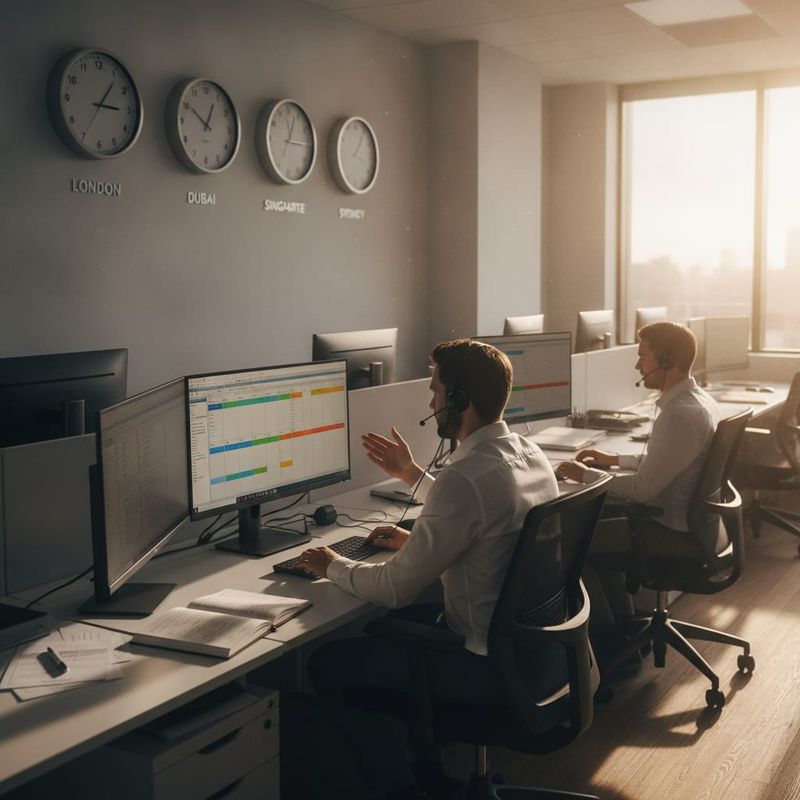
Calling hours are set per country, in the called party's local time, and the tightest rule wins. In the United States, 47 CFR 64.1200(c)(1) bars telephone solicitations to residential subscribers before 8am or after 9pm local time. Australia's Do Not Call Register standard permits weekday telemarketing calls from 9am to 8pm and Saturday calls from 9am to 5pm, with no calls on Sundays or national public holidays.
The FCC rule is short enough to quote in full: "No person or entity shall initiate any telephone solicitation to any residential telephone subscriber before the hour of 8 a.m. or after 9 p.m. (local time at the called party's location)," per 47 CFR 64.1200(c)(1). The FTC's Telemarketing Sales Rule at 16 CFR 310.4(c) sets the same 8am to 9pm window and adds a pacing rule: no more than 3% of calls answered by a person may be abandoned, measured over each 30-day period.
| Market | Weekday hours | Weekend | What else to check |
|---|---|---|---|
| United States | 8am to 9pm (47 CFR 64.1200) | Same federal clock; states can be tighter | DNC registry copy no older than 31 days; company opt-outs kept 5 years |
| Australia | 9am to 8pm | Saturday 9am to 5pm; no Sunday calls | No calls on national public holidays; wash the list against the Do Not Call Register |
| UK and EU | Set with compliance; the template starts at 09:30 to 19:30 | Confirm per country | TPS screening in the UK; GDPR lawful basis and national registers in the EU |
| Gulf and MENA | Template starts at 10:00 to 20:00 | The weekend day differs by country | Prayer times and Ramadan move the windows |
Two US details trip up brokers who run global books. The national do-not-call registry copy you screen against must be, in the rule's words, "obtained from the administrator of the registry no more than 31 days prior to the date any call is made." And a trader who tells your agent "don't call me again" goes on a company-specific list that "must be honored for 5 years from the time the request is made." A dormant list screened once at campaign launch drifts out of compliance within a month. The TCPA rules for AI calling cover the consent side, which is a separate check from hours.
Write the windows down per country and get the compliance desk to sign the sheet before anything is loaded. The Forex Reactivation Call Cadence Template is that sheet: calling windows by region, a four-attempt schedule, retry rules for no-answer, busy and failed calls, and the stop conditions.
3. Should Broker Calls Follow the Forex Trading Sessions?
No, not for most dormant segments. The trading session tells you when the market is busy, not when the trader is free. A trader who stopped after a losing month isn't watching the London open, and a trader who still checks charts doesn't want a sales call in the first hour of it. Use session times to block an hour, never to pick one.
The sessions matter because of where the volume sits. The BIS Triennial Survey put daily FX turnover at $7.5 trillion in April 2022, with the United Kingdom handling 38% of it, the United States 19%, Singapore 9%, Hong Kong 7% and Japan 4%. Those five centres carry 78% of the market. That's why so many active retail clients live on London and New York time even when they sit in Limassol or Johannesburg.
For the recently quiet segment, block the first hour after London opens and the first hour after New York opens. A call then interrupts the one thing that might bring the trader back on their own. For traders quiet a year or more, ignore sessions. The reasons they went inactive have more to do with a stop-out or a job change than with a session clock.
4. How Soon After a Trader Goes Quiet Should You Call?
Sooner than most brokers do. Set the first call at 30 to 45 days without a trade for accounts that still hold a balance, and at 60 to 90 days for zero-balance accounts, then run four attempts over 12 days with at least 48 hours between them. The trader dormant for six months has usually found another broker or another hobby. The one dormant for five weeks still has your app on their phone.
Days aren't the only trigger. A KYC document expiring next month is a better reason to call than an arbitrary 90-day mark, and that's a service call, not a pitch. A failed deposit is another: the card bounced and nobody followed up. A stop-out is the hardest, and it needs a low-pressure line and a two-week gap before the phone rings.
Money argues for speed. Every month a funded-but-idle account sits there is spread and commission you're not earning, and the figure is easy to put on paper. Run your own book through the dormant trader revenue calculator with your average monthly revenue per active client and the share of dormant accounts you'd expect a call to bring back. Then compare the result with a customer reactivation campaign billed at $0.35 a minute with no per-seat or setup fees.
The MT4 or MT5 export tells you the last trade date, but the CRM tells you the last conversation date. Use both. A trader who spoke to an account manager three weeks ago doesn't need a call yet; a trader nobody has spoken to in five months does. Reactivating dormant trading accounts with AI voice agents covers the data prep.
5. How Should Retries Be Timed After No Answer?
Retry in a different window, never the same one. The cadence template runs four attempts over 12 days: attempt one in the trader's evening window, attempt two 48 hours later in the morning, attempt three at midday around day seven, and a courtesy close in the evening on day 12. A busy signal gets a short retry the same day. A failed number gets one recheck, then a data flag.
Stop conditions matter as much as the schedule. Answered and declined means stop. "Don't call me" means suppression for good, and in the US that's at least five years under 64.1200(d)(6). A voicemail counts as an attempt, because the trader now knows you called. Two calls in the same day to a number that didn't pick up reads as harassment and produces complaints, not deposits.
Pacing is the quiet part of timing. The Telemarketing Sales Rule's 3% abandonment cap over a 30-day period exists because dialers that call faster than they can speak leave people holding a silent line. An AI agent answering within 500ms removes the dead air, but it still needs to be told how many attempts, how far apart and when to give up. Building a forex reactivation call cadence walks through the full schedule, and handling failed calls and campaign recovery covers what to do when a whole window underperforms.
6. What Does an AI Voice Agent Change About Call Timing?
An AI voice agent removes the shift problem. A human desk in Limassol covers two, maybe three regional windows a day; an AI agent runs the Sydney evening, the Dubai midday and the London morning at the same time, in each trader's language, and routes the callbacks into the account managers' office hours. Topcalls runs 63,000+ AI calls a day across its customers, in up to 78 languages, at $0.35 a minute all-inclusive.
Timing stops being a staffing question and becomes a configuration one. In Smart Campaigns you set the windows per country, the attempt count and the gap between attempts, and the campaign dials inside those limits. The AI voice agent answers with sub-500ms latency, so the first thing a trader hears is a voice, not a click and a pause. Human teams working alongside it see a 3 to 10x lift in call volume.
The handoff is where timing comes back. A trader who says "call me tomorrow at 7pm" needs an account manager who is actually there at 7pm, so the evening window only opens if someone owns it. When an AI call should hand off to a human covers the rules. On the compliance side, TCPA, TSR, DNC and GDPR duties stay with you, Topcalls dials only inside the hours you set, and the platform runs at 99.9% uptime, which matters when a window is only two hours long.
Setup is quicker than the planning. A first campaign takes about 15 minutes to configure and is usually live within about two weeks. If you'd rather see it on your own dormant segment before committing, book a 30-minute call and you'll have a proposal within 48 hours.
7. When Does the Best Time to Call Not Matter?
Timing can't fix a list you shouldn't call, an offer nobody wants or a book too small to learn from. If a number is on a do-not-call list, has no consent basis, or belongs to a trader who asked you to stop, the best window is none. And under about 500 accounts, run one window and read the transcripts instead of testing three.
- No consent or a DNC hit: the call doesn't happen, whatever the hour. Screening comes before scheduling.
- Unknown weekend rules: if nobody on the team knows which day is the weekend in a country you're dialling, don't open a weekend window there until someone finds out.
- Dormant three years or more: the phone number is probably stale and the relationship is colder than a call can warm. Email first, then one call to the numbers that respond.
- The offer is the problem: a trader who left after a bad experience doesn't come back because you called at a better hour. Fix what the agent says before you tune when it says it.
- Nobody owns the pause button: every window you open needs a named person reachable during it. If that's nobody at 7pm Sydney time, the Sydney evening window stays closed.
Pick the trader's clock, write the windows down per country, get compliance to sign the sheet, then read the connect rate by window after the first week.
Frequently Asked Questions
Get AI calling tips in your inbox
No spam. One email per week with actionable sales automation tips.