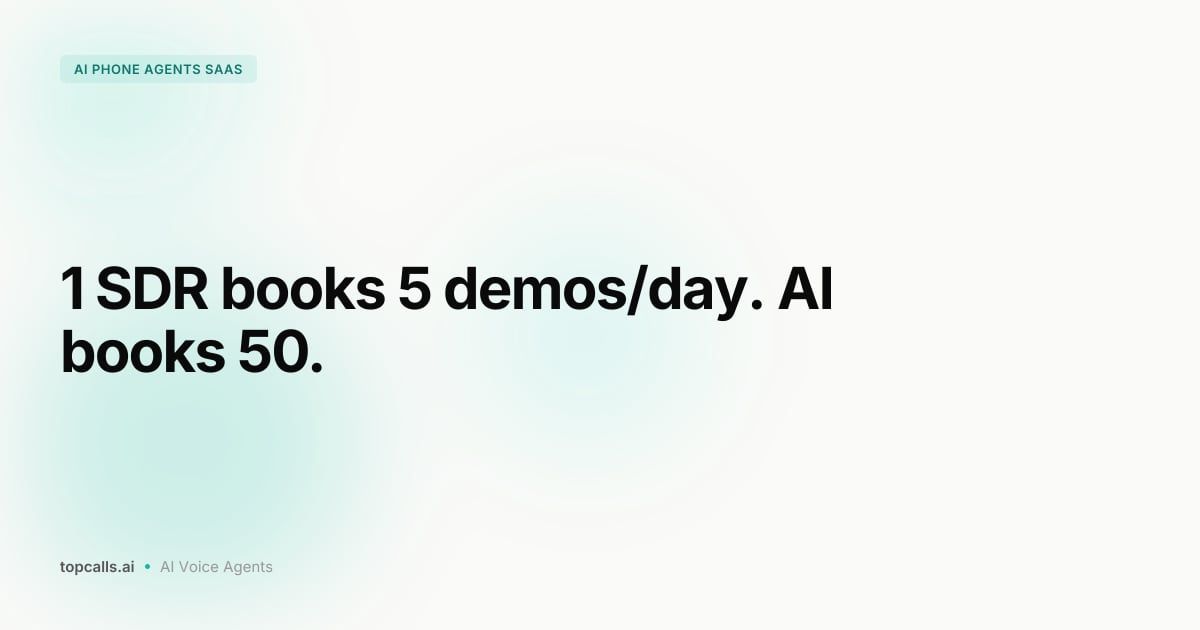
Your SDR team books 4 to 6 demos per person, per day when things are running well. An AI phone agent on the same lead list books that many in an hour. That's not a sales pitch. It's what happens when you stop treating appointment setting like a headcount problem and start treating it like a volume problem.
AI phone agents for SaaS appointment setting call leads, qualify them against your criteria, and book demo slots directly into your calendar. No human needed until the meeting is confirmed. This guide covers how to deploy them, what metrics to expect, and where they actually fall flat. If you're evaluating automated outreach, start with our appointment setting solution overview first.
Key Takeaways
- A human SDR books 4 to 6 demos a day, while a TopCalls AI phone agent books that many in a single hour on the same list.
- TopCalls agents answer with sub-500ms voice latency, so the pause never registers as a recorded message.
- At $0.35 per minute, a 3-minute call costs $1.05 and lands around $28 per booked demo, versus $50 to $200+ for a human SDR.
- TopCalls connects natively to Salesforce, HubSpot, Pipedrive, Close, Google Calendar, Calendly, and Cal.com, plus 5,000+ apps via Zapier.
- Most teams go live in under two weeks, expect a 60%+ connect rate lift and a 10% to 20% demo booking rate on connected calls.
1. Why SaaS Appointment Setting Stalls at Scale
The SDR model has a ceiling. A new rep takes 3 to 4 months to ramp fully and costs $60,000 to $80,000 per year loaded with salary, benefits, tools, and management overhead. A strong rep maxes out at 80 to 100 dials per day. That's it. And most SaaS teams hit that ceiling long before they run out of leads.
There's also a speed problem. Harvard Business Review found that sales reps who follow up within an hour are 7x more likely to have a meaningful conversation with a decision-maker. Most SaaS teams don't have the headcount to call every inbound lead within 60 minutes. Some leads wait hours. Some until the next morning. By then, they've already booked a demo with a competitor.
AI agents fix both constraints. They don't ramp. They don't have slow mornings or get tired after 60 calls. And they call every new lead the moment it lands in your CRM, regardless of the time.
2. How AI Phone Agents Work for B2B Appointment Booking
The mechanics matter here. Modern AI voice agents answer with sub-500ms voice latency. That gap between what a prospect says and what the agent responds is fast enough it doesn't register as a pause. The conversation feels normal. Not like an IVR menu. Not like a recorded message.
During the call, the agent follows your script, handles common objections, qualifies the prospect against your BANT or MEDDIC criteria, and books directly into a connected calendar if they agree to a meeting. Everything syncs back to your CRM in real time. No manual data entry.

After a missed call, smart retry logic kicks in. Busy signal? Retry in minutes. Rang but no answer? Try again in a few hours. The lead doesn't slip through because one call didn't connect. TopCalls processes 63,000+ AI calls daily across these retry sequences.
Want to run the numbers for your team? Use our AI cold calling ROI calculator to see the cost-per-meeting math for your lead volume and current close rate.
3. Step-by-Step: Deploying AI Phone Agents for SaaS Demo Booking
Most teams get their first AI calling campaign live in under two weeks. Here's the deployment sequence that works.
Step 1: Define Your ICP and Qualification Criteria
Before you write a word of script, define exactly who you're calling. Company size range, target industry, relevant tech stack, job title. What makes a lead qualified? What's a hard disqualifier? Write it out explicitly. Your AI agent needs clear rules to qualify or skip a prospect. Vague criteria produces vague results.
Step 2: Build Your Script and Objection Handling Map
This isn't a rigid phone tree. It's a conversational guide. Write an opening under 15 seconds. Then a value statement, one sentence, specific. Then 3 to 4 qualification questions. Then a direct booking ask. After that, map the 5 to 6 objections you hear most often and write a response for each. "Not the right person" needs a different answer than "Send me an email first."
Step 3: Connect Your CRM and Calendar
TopCalls integrates directly with Salesforce, HubSpot, Pipedrive, and Close for CRM sync. For calendar booking, it connects to Google Calendar, Calendly, and Cal.com. The agent books open slots without a human in the loop. For anything outside the native integrations, check the full integrations library. It covers 5,000+ apps via Zapier.
Step 4: Test with a Controlled Batch First
Don't start with your entire list. Pull 200 to 300 leads and run them through the campaign. Listen to a random sample of recordings afterward. You'll catch the exact moments where calls fall apart before they affect thousands of prospects. Most teams find one or two script issues in the first batch that would have killed conversion at scale.
Step 5: Measure, Adjust, Then Scale
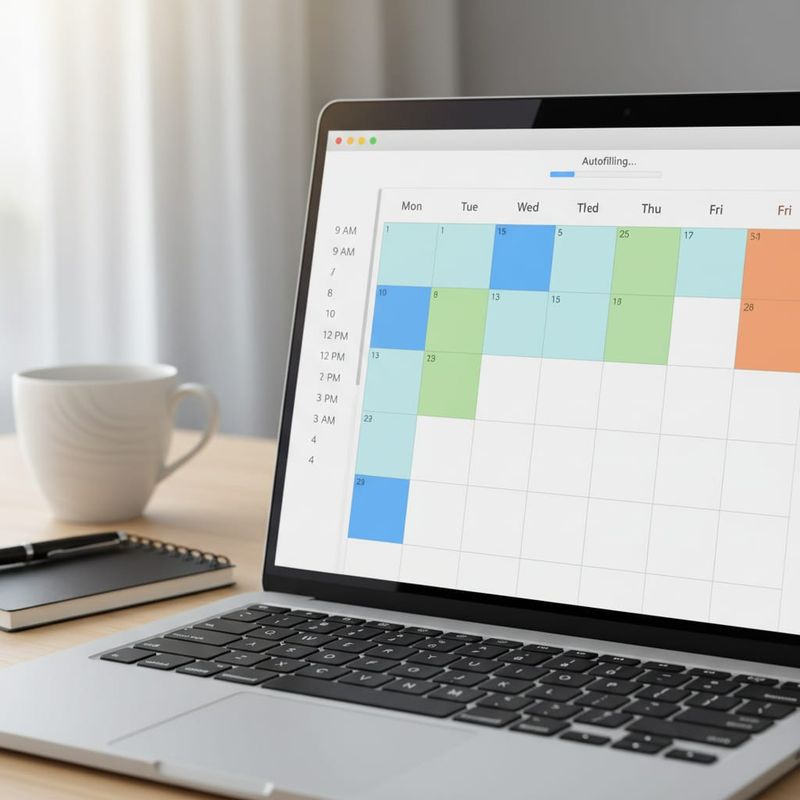
After the test batch, track connect rate, average call duration, and demo booking rate. Connect rate under 20%? Your list quality or call timing needs work. Connected calls not booking? The script or qualification criteria needs tightening. We cover the key AI cold calling metrics to benchmark against in a separate guide. Once numbers look right on the small batch, scale.
4. What Metrics to Expect from AI Appointment Setting
These are averages, not guarantees. Actual numbers vary by industry, ICP quality, and how tight the script is.
- Connect rate improvement: 60%+ over baseline. AI agents call systematically across all time slots and don't avoid difficult numbers or burn out at 4pm.
- Demo booking rate from connected calls: 10% to 20% for SaaS with a defined ICP and solid script. Higher if you're calling warm or inbound leads rather than cold outbound.
- Cost per booked meeting: At $0.35/minute, a 3-minute call costs $1.05. With a 15% booking rate on connected calls and a 25% connect rate, you're at roughly $28 per booked demo. Human SDR cost per meeting typically runs $50 to $200+ depending on comp structure and tooling.
- No-show reduction: AI agents send automated confirmation and reminder calls before each meeting. Teams using this typically see no-show rates drop 22% to 25%.
If you want a real-world benchmark, read how one agency replaced three SDRs with AI calling and tripled their pipeline in the AI SDR case study. The numbers are specific.
5. AI vs. Human SDRs: When to Use Each
Here's the honest version of this comparison.
AI phone agents win on volume, speed, and consistency. They can run thousands of simultaneous calls, respond to an inbound lead 30 seconds after form submission, and deliver the same script quality on call 500 as call 1. For SaaS companies selling to SMBs and mid-market, AI handles first-touch outreach and meeting booking better than most human SDRs in most cases.
Human SDRs win at depth and adaptability. Multi-stakeholder enterprise deals, objections that weren't in the playbook, conversations where reading tone and hesitation matters. They're also better when the deal needs real discovery before any meeting makes sense.

The setup most SaaS teams land on: AI books the meeting, the human takes it. Your AEs spend 3 hours in demos instead of 3 hours on cold outreach. That's the actual ROI shift. We break down the full cost comparison in the SDR cost vs. AI sales agent guide if you want to run the numbers against your team size.
6. Where AI Appointment Setting Doesn't Work
Worth being direct about this before you commit budget.
High-touch enterprise deals with 12+ month sales cycles don't fit well. When every call needs deep discovery before a meeting makes sense, and when a prospect needs to feel a relationship before they'll give you 45 minutes, AI underdelivers. Those accounts need a human who can read between the lines.
It also doesn't make economic sense when your total prospect list is small. If you're targeting 500 companies globally, the setup and tuning time probably won't return more than a good human SDR would. AI appointment setting pays off at volume. Under a few thousand leads, the case weakens.
And it won't fix a weak value proposition. If the message doesn't land with human SDRs, it won't land with an AI agent either. The mechanics improve. The message still has to do the work.
7. Integrating AI Agents with Your SaaS Stack
For this to work at scale, data has to flow correctly. Here's what the integration layer looks like in practice.
- CRM sync: After each call, lead status updates automatically. Connected-and-booked, connected-and-not-interested, and no-answer all write different outcomes to the lead record. Your follow-up sequences pick up from the right state without manual tagging.
- Calendar booking: The agent books directly into the right rep's calendar, generates a meeting link (Zoom or Google Meet), and fires a confirmation email to the prospect. No scheduling back-and-forth.
- Zapier and beyond: For tools outside the direct integrations, Zapier handles 5,000+ apps. Trigger Slack notifications on bookings, update rows in Airtable, or push data to Outreach and Salesloft.
If you're building out a full AI-powered outbound stack and not just the calling layer, read our guide on AI sales automation for SaaS. It covers how to connect dialing, email, and CRM workflows into a single pipeline without adding headcount.
If your pipeline problem is a capacity problem, and in most SaaS companies it is, AI phone agents fix it faster and cheaper than hiring another SDR. Setup takes under two weeks. The first test batch tells you what to adjust. And at $0.35/minute with no ramp time and no quota drama, the economics are hard to argue with.
Want to see how this works for your specific ICP? Book a strategy call and we'll walk through a real deployment plan.
Frequently Asked Questions
Get AI calling tips in your inbox
No spam. One email per week with actionable sales automation tips.