A failed deposit is the warmest lead your brokerage has, and the one it drops fastest. Failed deposit follow-up automation closes that gap: the payment provider fires a decline event, an AI agent calls the trader inside 15 minutes, works out which decline reason they hit, and sends the fix by SMS while the card is still on the desk. Topcalls runs those calls at $0.35 per minute, all-inclusive, so a three-minute recovery call costs $1.05.
This guide covers the trigger, the decline-code branches, the call timing, the script, the compliance gates, and how to get a first recovery campaign live. It's written for the head of conversion who can see the failed deposits in the payments dashboard and knows nobody is calling them.
Key Takeaways
- Stripe's reference lists more than 50 card decline codes, and for do_not_honor and generic_decline the only documented next step is contacting the card issuer.
- For insufficient_funds and expired_card, Stripe's guidance is a different card or payment method, which is a conversation with the trader, not a retry.
- Topcalls runs failed deposit follow-up calls at $0.35 per minute all-inclusive, so 500 failed deposits called twice at three minutes each cost at most $1,050 a month.
- Under the US Telemarketing Sales Rule, calls to a residence stay between 8:00 a.m. and 9:00 p.m. local time, so late-night failures queue for morning.
- Strong Customer Authentication has applied to European online card payments since 14 September 2019, and banks decline transactions that skip it, so 3D Secure gets its own call branch.
1. Why do forex deposits fail in the first place?
Deposits fail because the trader's bank declines the authorization, the payment provider blocks it, or the trader never finishes the authentication step. Stripe's decline code reference names the reasons: insufficient funds, an expired card, an incorrect CVC, authentication required, a velocity limit, and a long tail of "declined for an unknown reason" codes such as do_not_honor. Each needs a different fix, and the trader rarely knows which one they hit.
The unknown-reason codes are the painful ones. For do_not_honor, generic_decline, call_issuer and half a dozen similar codes, Stripe's documented next step is the same line: the customer needs to contact their card issuer for more information. The trader sees a red banner, assumes your cashier is broken, and closes the tab. Nobody at the brokerage knows whether the card was over its limit or flagged by the bank's fraud model.
European deposits add a second failure point. Strong Customer Authentication under PSD2 has been in force since 14 September 2019, and Stripe's SCA guide says customers' banks might decline transactions that don't follow the authentication guidelines. A trader who closed the 3D Secure pop-up, or whose banking app never delivered the push notification, shows up in your data as a failed deposit with the code authentication_required.
| Decline reason | What the trader saw | What the follow-up call does | Retry the same card? |
|---|---|---|---|
| insufficient_funds | "Card declined" | Offer a smaller amount or another method | No, Stripe says use another method |
| expired_card | "Card declined" | Ask for a current card, send the cashier link by SMS | No |
| authentication_required | 3D Secure pop-up, or nothing | Walk through the banking-app approval, resend the link | Yes, with authentication |
| do_not_honor / generic_decline | "Card declined", no reason | Ask the trader to call the bank, offer another method now | Only after the bank clears it |
| card_velocity_exceeded | "Card declined" | Split the deposit or switch cards, log the limit in the CRM | Later, or another card |
Bank transfers fail differently: the money leaves, the reference is wrong or missing, and the trading account never gets credited. That's a finance-desk reconciliation problem with a call attached, and the workflow routes it separately.
2. What does failed deposit follow-up automation actually do?
Failed deposit follow-up automation turns a decline event into a phone call without a human touching it. The payment provider posts a webhook with the account ID, amount, method and decline code. A rule checks consent, DNC status and local calling hours, then an AI voice agent dials the trader, names the reason in plain language, offers the fix, and writes the outcome to the CRM.
Five pieces make up the workflow:
- Trigger: the decline event from the PSP or your cashier, carrying the decline code, amount, currency and method. Topcalls connects to 764+ tools through its Integrations path, so the trigger can come from the payment provider, the CRM, or the trading platform's back office.
- Gates: a consent flag on the account, a DNC and internal opt-out check, a jurisdiction check, and the calling window for the trader's country. Fraud-coded declines never pass this gate.
- The call: an AI voice agent in the trader's language, up to 78 languages available, with sub-500ms response latency so the trader can interrupt and be heard.
- The fix: an SMS with a link back to your cashier or a different payment method. The AI never takes card numbers on the call.
- Write-back: the outcome, the decline branch and the next step land on the CRM record, which brokerage CRM call outcome automation covers step by step.

Compared with a first-time deposit follow-up, which chases a trader who hasn't tried to fund yet, a failed deposit call has one advantage: the trader already decided. The job is to remove whatever the bank put in the way.
The Deposit Follow-Up Workflow Template lays this out for first-time, abandoned and failed deposits in one fill-in sheet: triggers, timing, call goals, CRM updates and escalation.
3. How fast should the failed deposit call go out?
Inside 15 minutes of the decline, held to legal calling hours in the trader's country. The trader is still at the desk with the card in hand. Under the US Telemarketing Sales Rule, outbound calls to a residence stay between 8:00 a.m. and 9:00 p.m. local time at the called person's location, so a failure at 11 p.m. in New York gets queued for 8 a.m., not dialed.
A call that lands while the banner is still on screen sounds like service. The same call the next morning sounds like sales.
The attempt schedule matters as much as the first call. A decline gets three attempts at most: one at 15 minutes, one four hours later or at the opening of the next legal window, and one the following day. After that the trader goes to email and the campaign stops dialing. A trader who declined twice to fix a deposit isn't going to fix it on attempt six.
If the decline event takes 40 minutes to reach the dialer because it's batched, the 15-minute target is fiction. How AI voice agent webhooks and APIs work walks through the event-driven setup that keeps the trigger under a minute.
4. What should the call say to a trader whose deposit failed?
The call names the failure, offers a fix, and gets the trader back to the cashier in under three minutes. It opens by identifying the broker and the AI, confirms it's about the deposit attempt from a few minutes ago, and asks one question: did your bank show you anything? The branch then follows the decline code. No card numbers, passwords or identity documents are taken on the call.
Each branch is short and specific to the code the PSP returned:
- Insufficient funds: "Your bank didn't approve that amount." Offer a lower amount or a different method, then send the cashier link by SMS. Stripe's guidance for this code is an alternative payment method, so don't push a retry.
- Authentication required: "Your bank wanted you to approve it in the app." Stay on the line while the trader opens the banking app, then resend the link so the 3D Secure step runs again.
- Unknown reason: "The bank declined it without telling us why. A quick call to the number on the back of the card usually clears it." Offer another method now so the deposit doesn't wait on the bank.
- Expired card: ask whether they have a current card, send the link, done. Under a minute.
What the call never offers is money. The FCA's PS19/18 requires firms to stop offering current and potential customers cash or other inducements to encourage retail consumers to trade. So the offer is help with the payment, not a credit for making it. Brokers under other regulators should treat that as the floor.
Questions about spreads, margin or regulation go to a licensed account manager by warm transfer. The AI handles the payment; it doesn't give investment advice. A trader whose account hasn't cleared verification gets routed to the KYC reminder flow instead, because a deposit into an unverified account is a different conversation.
5. What does failed deposit follow-up automation cost?
$0.35 per minute on Topcalls, all-inclusive: the voice model, telephony, recording, transcription and analytics, with no per-seat, setup or bundle fees. A three-minute recovery call costs $1.05. A broker with 500 failed deposits a month, calling each up to twice, spends at most $1,050 if every attempt runs the full three minutes, and less in practice because no-answers and voicemails bill by the second.
The break-even is arithmetic, not a benchmark. If your average failed deposit is $500, the campaign covers that $1,050 outside cost by recovering three deposits in the month. Put your own decline volume and average deposit into the dormant trader revenue calculator to see the number.
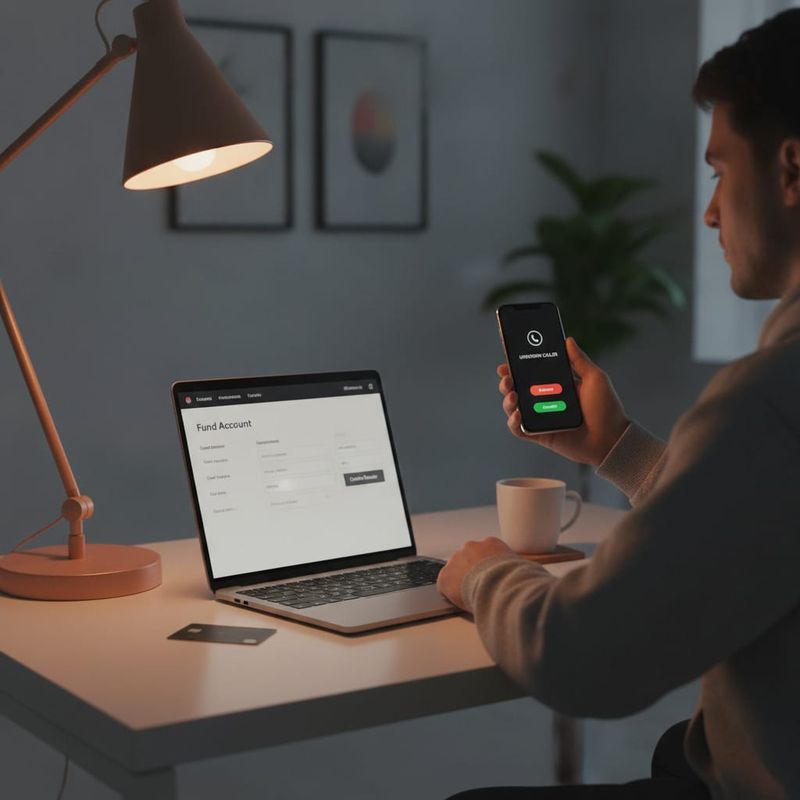
Compare that with a manual callback desk. An account manager who works failed deposits between other tasks reaches them when there's a gap, usually the next day. The cost isn't the salary; it's the deposits that were fixable at minute 15 and gone by hour 20. Topcalls reports a 60%+ connect-rate lift on its campaigns against the same lists dialed by hand, and every call carries a transcript.
6. How do you keep failed deposit calls compliant?
Treat every failed deposit call as a financial promotion to an existing client and run it through the same gates as any outbound campaign: consent on file, DNC screening, calling-hour rules, an AI disclosure at the top of the call, and a full recording plus transcript for the compliance desk. Topcalls records and transcribes every call.
An existing client relationship doesn't override an internal opt-out. A trader who asked not to be called last quarter stays suppressed even when their card fails today, and the workflow sends the fix by email instead. For European traders, the lawful basis and retention period for the call recording need writing down before launch; GDPR for AI outbound calling covers the checklist.
Card data stays off the recorded line. The AI sends a link to your own cashier and the trader types the card in there. Recordings, transcripts and call metadata sit on secure infrastructure with role-based access, so the compliance desk can pull any call by account ID.
Fraud-coded declines get special handling. Stripe's guidance for fraudulent, lost_card and stolen_card is to give the customer no detail at all and present the decline as generic. A brokerage that calls those traders and reads out the reason has tipped off a possible fraudster. Those events go to the compliance desk, not the dialer.
7. When doesn't failed deposit follow-up automation fit?
It doesn't fit when the decline carries a fraud signal, when the trader hasn't cleared KYC, when the brokerage isn't licensed to solicit in the trader's country, or when the volume is under a few dozen failures a month and one account manager can call them by hand. Automation earns its keep on volume, speed and consistency; below that line it's overhead.
- Fraud-coded declines: suppress them. Compliance reviews, nobody calls.
- Pre-KYC accounts: a failed deposit from an unverified account is a verification problem first. Fix the documents, then the payment.
- Unlicensed jurisdictions: if your entity can't solicit in the trader's country, the decline doesn't change that. Route to a passive email.
- Very low volume: under about 30 failures a month, a named account manager with a 15-minute alert does the job.
- Bank transfer mismatches: the money is in transit; a call to the trader can confirm the reference, but the fix sits with the finance desk.
The abandoned deposit follow-up case is different again: the trader left the cashier before pressing pay, so there's no decline code to branch on and the call asks what stopped them. Keep the two campaigns separate.
8. How do you build the first recovery campaign?
Start with one payment method, one decline branch and one language. Connect the decline webhook, write the four script branches, set the calling windows and the three-attempt cap, and run it on a week of failures before widening. On Topcalls, live campaigns typically run within two weeks, and a proposal follows within 48 hours of a strategy call.
- Export the last 30 days of failed deposits with their decline codes and count by code. The biggest bucket is your first branch.
- Connect the decline event through Integrations and fire a sandbox decline end to end. Measure the seconds from event to dial.
- Write the four branches and the disclosure line, then get the compliance desk to sign the script, not a summary of it.
- Set calling windows per country, cap attempts at three, and load the DNC and fraud-code suppressions before the first live call.
- Track reach rate, deposits recovered within 24 hours, and cost per recovered deposit, and write every outcome back to the CRM.
The same trigger-and-branch setup runs the rest of follow-up automation at a brokerage, from KYC reminders to demo expiry, so the first campaign becomes the template for the next four. To walk through the decline export with someone, book a 30-minute call and bring the file. The proposal lands within 48 hours.
Frequently Asked Questions
Get AI calling tips in your inbox
No spam. One email per week with actionable sales automation tips.