A trader just made their first deposit, and the next 15 minutes decide whether that money ever gets traded. First-time deposit follow-up automation is the fix: a call fires from the payment processor's confirmation, reads the amount back to the trader, checks that the funds show in MT4 or MT5, and books one next step, with no sales agent watching a queue.
Most brokers handle the first-deposit call the way they handle a support ticket: whenever someone gets to it. This guide covers the trigger, the timing, what the AI agent says, how outcomes land in the CRM, what a call costs at $0.35 per minute, and the compliance checks that come before the first dial.
Key Takeaways
- A first-time deposit follow-up call is a service call: confirm the money landed, check the first login, book one next step, and never pitch a larger deposit.
- Trigger the call from the payment processor's webhook, not a CRM copy of it, and dial 15 minutes after confirmation by default.
- ESMA found 74-89% of retail CFD accounts lose money, so the first funded week is where a broker earns the trust it will need later.
- Topcalls runs first-deposit calls at $0.35 per minute all-inclusive, in up to 78 languages, with real-time replies; a four-minute call costs $1.40.
- Every call ends with one CRM outcome code such as FTD_CONFIRMED or FTD_QUESTION, written to the record before the next call dials.
- FCA rules stop UK brokers offering inducements to retail CFD clients, and the FCC treats AI-generated voices as artificial under the TCPA, so each script gets a compliance sign-off first.
1. What is first-time deposit follow-up automation?
First-time deposit follow-up automation is a workflow that watches for a trader's first successful deposit, waits a set number of minutes, and places a call that confirms the funds arrived, checks the platform login, answers early questions and books a next step. The trigger comes from the payment processor, the call comes from an AI voice agent or a human, and the outcome writes back to the CRM.
The word automation does the work here. A conversion desk can call first-time depositors by hand, and plenty do. What they can't do is call every one of them 15 minutes after the money lands, at 11pm on a Saturday, in Portuguese, while three other deposits arrive. An AI voice agent can, and it doesn't skip the small deposits when the big ones show up.
Topcalls treats this as one campaign type inside its follow-up automation product: the deposit event arrives through Integrations, the campaign dials, the outcome flows back. The same workflow template covers abandoned and failed deposits, which have their own guides on abandoned deposit follow-up and failed deposit follow-up automation.
2. Why does the first deposit call matter so much?
The first deposit is the one moment when a trader has committed money and hasn't yet lost any. ESMA's analysis found 74-89% of retail accounts lose money on CFDs, with average losses per client between EUR 1,600 and EUR 29,000. A broker that calls within the hour, confirms the funds and helps with the first login is the broker the trader still trusts when the first losing week arrives.
There's a harder reason too. A first deposit that sits untraded for a week is a deposit that gets withdrawn or charged back. The trader funded, opened MT5, couldn't find the balance or the instrument they wanted, and moved on. Nobody called. Support never heard about it because the trader never wrote in.

The call catches that in four minutes. It also filters out the traders who need a human right away: a fraud flag, a disputed charge, someone who mentions a regulator. Those go to an account manager with the transcript attached, the same handoff Topcalls uses when it reactivates dormant trading accounts.
The deposit follow-up workflow template lays out each of the three deposit flows as a trigger, a wait time, a call goal, an outcome code and an owner, with blanks your ops team fills in.
3. What triggers a first-time deposit follow-up call?
The trigger is the first successful deposit on an account with no prior deposits, taken from the payment processor's webhook rather than a CRM record that copies it later. The default wait is 15 minutes, long enough for the balance to appear in MT4 or MT5 and short enough that the trader hasn't left the desk. Every trigger carries account ID, phone in E.164 format, language, amount, currency and payment method.
Source of truth matters more than it looks. If the CRM mirrors the PSP with a 20-minute delay, the call lands after the trader already placed a trade, and the agent asks a question the trader answered for themselves. Trigger from the processor. Use the CRM for suppression and the outcome, not for the event.
Two rules stop the workflow from annoying people. One follow-up per event, so a trader who deposits twice on day one gets one call. And a quiet window set in the trader's local time, not the office's, so a first deposit at 2am in Kuala Lumpur waits until 9am in Kuala Lumpur.
| Event | Source system | Fires when | Default wait |
|---|---|---|---|
| First-time deposit confirmed | PSP webhook | First successful deposit, no prior deposits | 15 minutes |
| Deposit abandoned | Cashier analytics, CRM stage | Cashier opened, no PSP transaction | 30 minutes |
| Deposit failed | PSP decline webhook | Issuer decline, 3DS failure, limit | 10 minutes |
| Deposit pending too long | PSP or bank status | Wire or crypto still pending | 24 hours |
When two events overlap, the KYC block wins. A trader with a pending verification can't retry a card, so the KYC reminder call is the only useful one. First-time deposit comes last in that order because it's the flow with the least urgency: the money already arrived.
4. What should the agent say on a first-deposit call?
The agent opens by naming the deposit amount and currency, asks whether it shows in the platform, and then checks three things: platform credentials received, first login done, funds visible in the account balance. It offers one next step, a platform walkthrough, a booked call with an account manager, or the education link by SMS, and it never pitches a larger deposit or a bonus.
Reading the amount back is the trust move. A phishing caller can't say 500 dollars by Visa at 14:12, and traders who've been burned before listen for exactly that. Topcalls loads the deposit fields into the call context so the agent says them in the first sentence, in the trader's own language, across up to 78 languages.
The no-upsell rule isn't politeness. The FCA's permanent CFD restrictions require firms to stop offering monetary and non-monetary inducements to encourage retail trading, in force since 1 August 2019, and ESMA's product intervention measures put a restriction on the incentives offered to trade CFDs across the EU. A deposit-another-200-and-we'll-match-it line on a first-deposit call is a financial promotion, and it needs compliance review before it reaches a script.
Anything the agent can't answer gets logged as FTD_QUESTION and routed to support the same day. A missing login, a balance that doesn't show, a question about swap rates. The call doesn't guess. Sub-500ms response latency keeps the exchange feeling like a conversation rather than an IVR menu, which is the difference between a trader staying on for all three checks and hanging up after the first.
5. How do call outcomes get back into the CRM?
Each call ends with one outcome code written to the CRM before the next call dials, along with the summary, transcript and recording link. Topcalls pushes those through Integrations, which connects to 764+ tools including HubSpot and Salesforce. The onboarding sequence starts only on FTD_CONFIRMED, so a trader with an open issue isn't hit with upsell emails the same afternoon.
| Outcome code | Meaning | CRM field | Next action |
|---|---|---|---|
| FTD_CONFIRMED | Funds visible, no open issue | deposit_followup_status = done | Onboarding sequence starts |
| FTD_QUESTION | Unanswered platform or account question | support_ticket_id | Support callback the same day |
| NO_ANSWER | No connect after all attempts | attempts_count, last_attempt_at | Email or SMS fallback, then close |
| DO_NOT_CALL | Trader asked not to be called again | dnc_flag = true | Suppress from every voice campaign |
Keep the list under ten codes. Longer lists stop being used, and a code nobody selects is a report nobody trusts. Every code maps to a field your reporting can filter on; if a code has no field, delete the code. The full disposition design is in our guide to brokerage CRM call outcome automation.
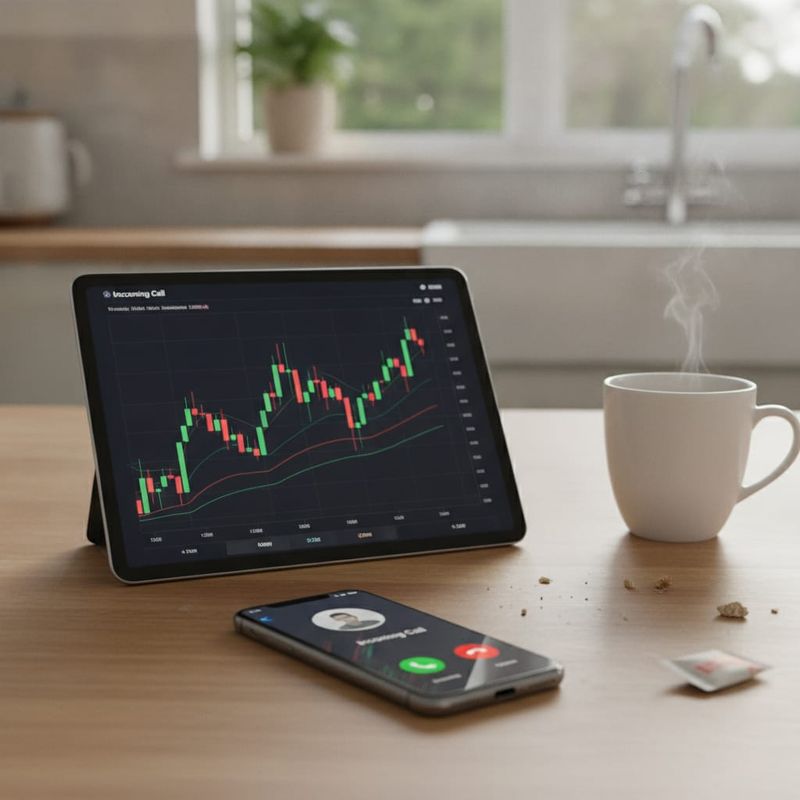
A trader who rings support ten minutes after the call should reach someone who can see it. That's the test for whether the sync is fast enough. Nightly batches fail it.
6. What does first-time deposit follow-up automation cost?
Topcalls charges $0.35 per minute all-inclusive, covering the voice model, telephony, recording, transcription and analytics, with no per-seat fee, setup fee or add-ons. A four-minute first-deposit call costs $1.40. A broker confirming 500 first deposits a month spends about $700 on calls, and the bill drops on a slow week because nobody pays for idle capacity.
Compare that with the human version. An account manager who spends four minutes on the call spends another six on the CRM update and the callback queue, and works one shift in one time zone. Brokers who keep a human team alongside Topcalls see that team handle 3-10x the call volume, because the humans only touch FTD_QUESTION and escalations.
Run your own numbers in the dormant trader revenue calculator, which takes list size, average deposit and connect rate and returns the cost per recovered trader. The same arithmetic works for first deposits: swap dormant accounts for first deposits per month. Our piece on AI voice agent user activation calls walks through the SaaS version of the same math.
7. Which compliance checks come before the first dial?
Five checks come before the first automated call: a documented lawful basis per jurisdiction, do-not-call screening against internal and national lists, an automated-call disclosure in the first sentence where required, a recording announcement, and calling hours set per trader time zone. Topcalls dials only inside the calling hours you set, the rest of the checks stay with you, and each of the three deposit scripts gets its own compliance sign-off.
The US line moved in 2024. The FCC's Declaratory Ruling of 8 February 2024 recognises that calls made with AI-generated voices are artificial under the TCPA, and the same release restates that telemarketers need prior express written consent before robocalling consumers. A service call about a transaction the trader started is treated differently from a marketing call in most regimes, but the moment the script mentions a bonus, it's marketing. Get counsel to draw that line for your book.
Two more items your compliance desk will ask about. The agent never asks for full card or bank details, and it can't be talked into it. And recordings sit under a written retention policy with a named period. Our guide to AI call disclosure requirements for brokers has the wording by region, and the secure infrastructure page covers where Topcalls keeps recordings and transcripts.
8. When doesn't first-deposit call automation fit?
Skip first-time deposit follow-up automation when one person can already call every first deposit within the hour by hand, when your PSP can't emit a reliable deposit event, or when a segment of high-value clients has a named account manager who calls first. Automation earns its keep on volume, timing and time zones. A small single-market desk that already calls fast doesn't need it.
Three more cases. If your CRM is the only place deposit status exists and it lags the processor by hours, fix the data feed first; a late call is worse than none. If you serve a jurisdiction where you can't document a lawful basis for an outbound call to a new client, that market stays on email until you can. And if your first-deposit script exists to upsell, no dialer will make it compliant.
What automation doesn't replace is the human callback. FTD_QUESTION and every escalation still land with a person. The AI agent takes the first four minutes so the account managers spend theirs on the traders who asked for one.
9. How do you launch first-deposit calls in two weeks?
The first Topcalls setup works like this: connect the PSP or CRM event through Integrations, load the first-deposit script, set the wait time and quiet window, pick a voice and a language. Live campaigns typically run within about two weeks, which covers the compliance sign-off, a test batch on your own team's numbers, and the outcome-code mapping into the CRM.
Start with first-time deposits alone. It's the lowest-risk of the three flows: the money already arrived, the call is a service call, and the outcome codes are the simplest. Add failed deposits second, since they carry the most recoverable revenue, then abandoned. Two weeks per flow is a comfortable pace.
If you'd rather have someone map your deposit events to call triggers with you, book a 30-minute call. We size the first-deposit volume from your PSP data and send a proposal within 48 hours.
Frequently Asked Questions
Get AI calling tips in your inbox
No spam. One email per week with actionable sales automation tips.