Most retail CFD accounts lose money, and the ones that stop trading after a bad week rarely hear from the broker again. Inactive CFD trader reactivation is the campaign that changes that: a planned run of calls to funded, KYC-approved accounts that went quiet, built around the reason each trader left instead of a generic "we miss you". This guide lays out the plan we run with CFD brokers: who to call first, what the AI agent says, where the FCA inducement ban and the US 540-day rule sit, and what it costs at $0.35 per minute.
Key Takeaways
- Inactive CFD trader reactivation targets funded, KYC-approved accounts with no trades for 30 to 90 days, called in order of last-trade recency and lifetime deposits.
- ASIC counted over 1.1 million CFD positions closed out under margin rules in five weeks of March and April 2020, the kind of event that empties a broker's active book.
- Under the US Telemarketing Sales Rule, a trader with a financial transaction in the last 540 days is an established business relationship and can be called without a registry match.
- The FCA stopped firms offering cash or other inducements to retail CFD clients, so a UK reactivation call sells the platform and the risk controls, never a bonus.
- Topcalls runs reactivation calls at $0.35 per minute all-inclusive, answers in real time, speaks up to 78 languages, and a first campaign usually goes live in about 2 weeks with managed setup.
1. What Is Inactive CFD Trader Reactivation?
Inactive CFD trader reactivation is a scheduled outreach campaign that contacts funded, KYC-approved CFD accounts with no trades or logins for a set period, usually 30 to 90 days, finds out why each trader stopped, and brings the willing ones back to a funded, trading state. The campaign runs on calls first, with email and SMS as support, because a two-minute conversation surfaces the reason a survey form never will.
The word "inactive" covers three very different people. One got closed out in a volatile week and never logged back in. One moved to a competitor with tighter spreads on the DAX. And one just forgot the app exists after the first deposit ran down. Each needs a different opening line, so segmentation comes before scripting.
If your book is mostly spot forex, the dormant forex account reactivation guide covers the same plan with forex-specific triggers. The steps below assume a CFD book, where margin close-outs and mandated risk warnings shape both the reason for leaving and what the call may say.
2. Why Do CFD Traders Go Inactive?
CFD traders go inactive for three reasons the regulator data supports: a margin close-out during a volatile stretch, a loss big enough that the trader decides to stop, or plain drift once the first deposit is used up. The numbers below show how common the first two are, which is why the call opens with a question, not an offer.
Start with the close-outs. ASIC's review of a five-week window in March and April 2020 found that retail clients of 13 CFD issuers made a net loss of more than $774 million, that over 1.1 million CFD positions were terminated under margin close-out arrangements, and that more than 15,000 retail accounts fell into negative balance owing $10.9 million between them. ASIC's summary of its own work: "ASIC reviews in 2017, 2019 and 2020 found that most retail clients lose money trading CFDs."
Europe reached the same conclusion two years earlier. When ESMA restricted retail CFDs in 2018, capping ratios at 30:1 for major currency pairs down to 2:1 for crypto, its analysis found that 74-89% of retail accounts lose money, with average losses per client between €1,600 and €29,000.
Read those figures as a broker. A trader closed out at 50% of required margin didn't decide to leave you. The market decided for them, and nobody rang afterwards to ask whether they'd come back with a smaller position and a stop in place. That's the account a reactivation call recovers. The wider pattern is in our guide to win-back campaigns for inactive trading users.
3. Which Inactive CFD Accounts Should You Call First?
Call the accounts most likely to fund again and least likely to complain: KYC-approved, a transaction in the last 540 days, stopped after a loss or a close-out rather than a full withdrawal, and a balance still sitting on the platform. Rank by recency of last trade, then by lifetime deposits. Park accounts withdrawn to zero more than 18 months ago for a later wave, after a consent review.

The back office already has every signal. MT4 and MT5 report last trade, balance, equity and margin call history per login; the CRM holds KYC status, deposits and the consent flag. Four segments cover most CFD books.
| Segment | Back-office signal | Priority | Call angle |
|---|---|---|---|
| Closed out, balance left | Margin close-out in last 90 days, equity above zero | First | Ask what happened, offer smaller-position setup and a callback |
| Stopped after a loss | Last trade a loss, no close-out, no withdrawal | Second | Ask what changed, point to risk tools and education |
| Drifted | No trade in 60 to 90 days, no loss event, small balance | Third | Short check-in, remind of the platform, agree next step |
| Withdrawn to zero | Full withdrawal, no login since | Later wave | Consent review first, then a single call asking why |
KYC status is the filter that bites hardest. A pending-KYC account that gets a redeposit pitch turns into a compliance ticket, so anything not fully approved goes to a separate KYC reminder flow. Balance band sets tone rather than targeting: $40 left after a drawdown gets a check-in, $4,000 idle gets a real conversation. The full scoring model, with dormancy age and region, is in the trader segmentation for reactivation guide.
4. What Should the Reactivation Call Say?
A reactivation call to an inactive CFD trader runs two to three minutes and has four parts: confirm the account holder and disclose that the caller is an AI agent for the brokerage, ask what stopped them trading, answer that reason plainly, and agree a next step. The next step is a callback with a human, a link to fund, or a clean "no" that suppresses the number for good.
- Open and disclose: "Hi, is this Daniel? This is an AI assistant calling on behalf of [Broker] about your trading account." Say the AI part in the first sentence. Traders who feel tricked hang up and complain; traders told upfront mostly keep talking.
- Ask, don't pitch: "I noticed you haven't placed a trade since March. What happened?" Then wait. The answer sorts the trader into closed-out, switched-broker or drifted, and picks the branch.
- Answer the reason: A close-out gets a plain explanation of the 50% margin rule and how a smaller position or a guaranteed stop would have changed the outcome. A switched-broker answer gets a specific question about spreads or execution, then a human callback if the gap is real.
- Agree the next step: A funding link by SMS, a booked callback with a named account manager, or a stop. Every ending writes a disposition to the CRM so nobody asks the same trader the same question twice.
In the UK and EU the agent can't dangle a deposit bonus. The FCA's CFD rules require firms to "stop offering current and potential customers cash or other inducements to encourage retail consumers to trade", as set out in PS19/18, so the pitch is the platform, the risk controls and the education, never free money. That makes the "what happened?" step matter more, not less. Word-for-word openers are in our AI caller scripts for dormant traders, and the branches for "I lost too much" and "your spreads are worse" are in AI voice objection handling for brokers. Topcalls' AI voice agents run those branches in real time, so the pause after the question sounds like a person listening rather than a system loading.
5. How Do You Keep Inactive CFD Trader Reactivation Compliant?
Keeping inactive CFD trader reactivation compliant takes three checks before the first dial: confirm each account still counts as an existing customer under local calling rules, confirm marketing consent hasn't been withdrawn, and confirm the script carries the standardised risk warning and no banned inducement. TCPA, TSR, DNC and GDPR compliance stays with you, and any opt-out heard on the call has to reach the suppression list you keep.
For US-facing books the existing-customer test is written down. Under the FTC's Telemarketing Sales Rule, an established business relationship exists when the person had "a financial transaction between the person and seller, within the 540 days immediately preceding the date of a telemarketing call", or made an inquiry within 90 days, per 16 CFR 310.2. A CFD trader who last deposited 14 months ago is inside the window. One who last traded two years ago needs a do-not-call registry scrub first, so keep the two groups on separate lists.
The risk warning travels with the call as well as the website. ESMA's 2018 measures require "a standardised risk warning, including the percentage of losses on a CFD provider's retail investor accounts", and the FCA applied the same rules to UK firms from 1 August 2019. Put the warning in the follow-up SMS and the funding page, and have the agent say a short version before any talk of trading again. Consent, recording notices and per-country rules are in compliant AI calling for forex brokers.
6. What Does the Campaign Cost, and How Do You Measure It?
Topcalls charges $0.35 per minute all-inclusive, covering the voice model, telephony, recording, transcription and analytics, with no per-seat, setup or add-on fees. A 3-minute reactivation call costs $1.05. The number to manage is cost per reactivated trader against the average redeposit for that segment, which decides whether a segment gets a second wave.
Four numbers, in this order, tell you whether it's working.
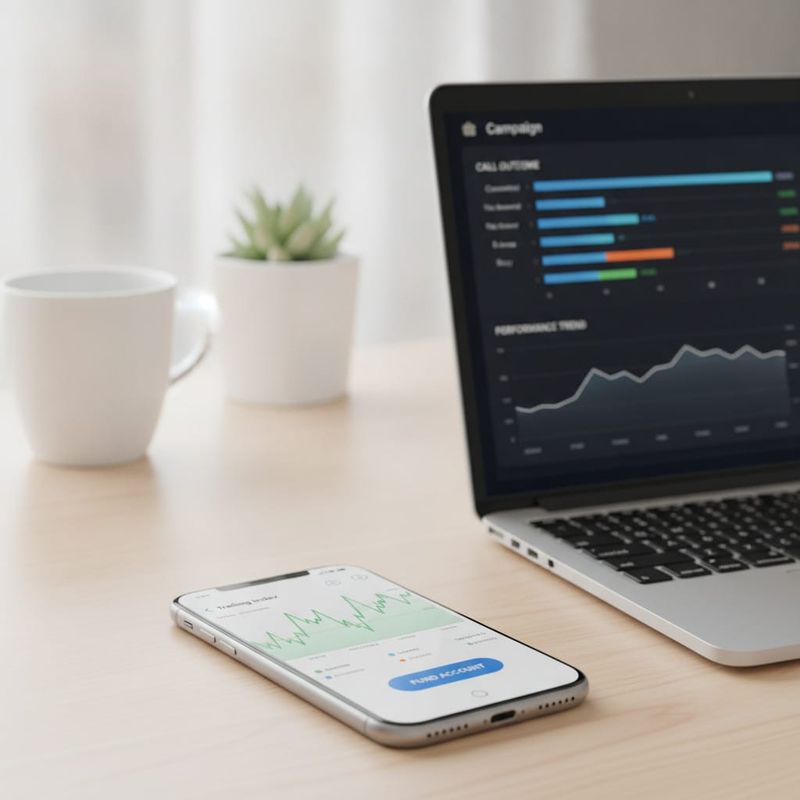
- Connect rate: Calls a human answered, out of calls placed. Topcalls reports a 60%+ connect-rate lift on its campaigns, driven by local numbers and call windows set per region.
- Conversation rate: Answered calls that got past the disclosure and the "what happened?" question. Low conversation with high connect means the opener is wrong, not the list.
- Redeposit rate: Traders who funded within 14 days of the call, out of traders reached. Tie it to the disposition, not the month, so an untouched account's redeposit doesn't get counted.
- Cost per reactivated trader: Total minutes times $0.35, divided by redeposits, against average first redeposit per segment. The worked formula is in cost per reactivated trader.
Run your own list through the dormant trader revenue calculator before the strategy call. It takes list size, expected reach rate and average redeposit and returns a recovery range and a minutes budget. Live figures per segment and call window sit in real-time analytics once the campaign is running.
7. How Do You Run the First Two Weeks?
The first two weeks of an inactive CFD trader reactivation campaign are a pilot: one segment, one language, one call window, a few hundred accounts. A proposal arrives within 48 hours of a strategy call, and most brokerages are live within roughly two weeks. The pilot proves the loop from MT5 export to CRM write-back before anyone scales it.
Days 1 and 2 are list work: export the closed-out segment with phone, first name, language, last trade, balance and KYC status, then run it through suppression and, for US numbers outside the 540-day window, the registry. Days 3 to 5 are script and QA: the four-part call above, risk warning wording signed off by compliance, and 20 test calls to internal numbers in the target language.
Days 6 to 10 are the calls, inside a window the segment actually answers. Every disposition lands in the CRM through Integrations, which connects to 764+ tools including HubSpot and Salesforce, so a "callback requested" tag creates the account manager's task the same minute. Days 11 to 14 are the review: connect, conversation, redeposit, cost per reactivated trader, and a call on which segment goes next.
Call windows and retry rules live in smart campaigns, and the wider approach to quiet clients is on the customer reactivation page. If you'd rather talk it through with your list in front of you, book a 30-minute call and bring the export.
8. When Doesn't Inactive CFD Trader Reactivation Fit?
Inactive CFD trader reactivation doesn't fit a brokerage with under a few hundred quiet accounts, a book with no consent trail, or a segment of high-value clients who already have a named relationship manager. It also doesn't fix the product: if traders left because spreads widened or execution slowed, the call surfaces that complaint clearly, but it doesn't remove it.
Three situations where we'd tell you to wait.
- Tiny inactive lists: A couple of hundred accounts is a week's work for one account manager with a phone. An AI campaign earns its keep in the thousands, where a human team can't reach every account inside the window that matters.
- No consent trail: If you can't show when and how each trader agreed to marketing contact, fix the data before the first dial. A campaign on an unconsented list is a regulator complaint waiting to happen, whatever the redeposit rate.
- Product problems dressed as engagement problems: If close-outs doubled after a platform change, or your DAX spread moved from 1 to 2 points, fix that first. Calling traders to ask why they left will get you the answer, loudly, from all of them.
Everything else, the mid-book of funded CFD accounts that went quiet for ordinary reasons, is what this plan is built for. The accounts already passed KYC and already funded once. What's missing is the call.
Frequently Asked Questions
Get AI calling tips in your inbox
No spam. One email per week with actionable sales automation tips.